

Are pet stairs safe for puppies still growing?
Pet stairs can be appropriate for a growing puppy when the steps fit their body, stay stable, and allow calm, supervised movement without jumping. They are not automatically safe because they are small or marketed for pets; pain, poor coordination, and a steep final climb are reasons to stop. For your puppy’s 2026 setup, choose comfortable access over reaching the furniture at any cost.
- Are pet stairs safe for puppies? Fit, stability, supervision, and your puppy’s health matter more than the product label.
- Furmatesusa pet stairs combine furniture access with storage; check the fit before choosing them for a puppy.
- A floor-level bed removes the need to climb when your puppy is unsteady or needs restricted activity.
- Stop stair practice if your puppy limps, cries, slips, or repeatedly jumps over the steps.
Are pet stairs safe for puppies still growing?
Pet stairs are a conditional option, not a blanket recommendation for every puppy. A healthy puppy that walks comfortably and takes each step with control presents a different situation from a puppy that scrambles, hesitates, or has a diagnosed joint problem.
Before letting your puppy use furniture stairs, follow this sequence:
- Check health first. Ask your veterinarian before introducing stairs if your puppy has pain, a previous injury, unusual movement, or activity restrictions.
- Check the whole route. Inspect the floor, each tread, the top transition, and the surface your puppy will reach.
- Observe both directions. Comfortable climbing does not prove that your puppy can descend safely.
- Teach voluntary movement. Reward calm exploration rather than pulling your puppy onto the steps.
- Control access afterward. Keep the route unavailable when you cannot supervise a puppy that is still learning.
For the teaching sequence, see how to train your dog to use pet stairs. Treat training as a fit check, too: repeated difficulty is a reason to change the setup, not demand more practice.
Why this matters
You want your puppy beside you for a quiet evening, not struggling to reach you. That makes the destination just as important as the steps: a puppy that reaches a sofa can still jump from another edge.
Growing puppies also change shape and movement as they develop. Recheck the setup as your puppy grows, rather than assuming an early comfortable fit will remain suitable throughout 2026.
Pet stairs provide a route. They do not prevent falls, diagnose readiness, or make an unsuitable furniture height appropriate.
Why puppy stair safety varies
The useful question is not simply whether puppies can climb. It is whether your puppy can use this particular route comfortably, in both directions, under the conditions in your home.
- Health and movement: Limping, stiffness, weakness, or an existing orthopedic condition changes the decision. Get individual veterinary advice rather than using stairs to work around symptoms.
- Body size and proportions: A tread that looks generous to you can leave a small puppy stretching between levels. Watch the movement instead of judging by appearance alone.
- Step shape: Your puppy needs room to place paws and move without leaping. An awkward final rise can undermine an otherwise manageable staircase.
- Traction and stability: A sliding base, shifting cover, or rocking structure creates an unreliable route. Check the flooring beneath the stairs as carefully as the stair surface.
- Behavior and supervision: A puppy that races, chews, or jumps sideways needs a different management plan from one that moves calmly.
- Destination and surroundings: Gaps, bedding that shifts, nearby clutter, and an open furniture edge all deserve attention. The route does not end at the top tread.
No single feature cancels out the others. Soft material does not correct poor fit, and a sturdy structure does not make a frightened puppy ready.
Are stairs, a ramp, or a floor-level bed better for my puppy?
Choose the setup your puppy can use without struggling; do not assume a ramp or stairs will always win. A ramp removes separate steps but still requires suitable traction, stability, and an appropriate slope.
For your 2026 bedroom plan, compare the whole arrangement rather than choosing by appearance alone.
| Option | Best for | Practical benefit | Limitation |
|---|---|---|---|
| Pet stairs | Puppies that comfortably negotiate the individual steps | Creates a defined route to furniture | Requires controlled stepping and a suitable top transition |
| Pet ramp | Puppies that manage an incline better than separate steps | Offers a continuous walking surface | A steep or slippery ramp remains unsuitable |
| Floor-level bed | Puppies that should avoid climbing or cannot use the route comfortably | Removes climbing from the resting routine | Does not provide independent access to your sofa or mattress |
| Owner-assisted access | Puppies whose veterinarian recommends assistance and whose owners can lift them safely | Lets you control the transfer | Requires safe handling and does not prevent a later jump down |
A floor-level sleeping spot is not a lesser choice. You can keep your puppy close beside your chair or bed without asking them to reach an elevated surface.
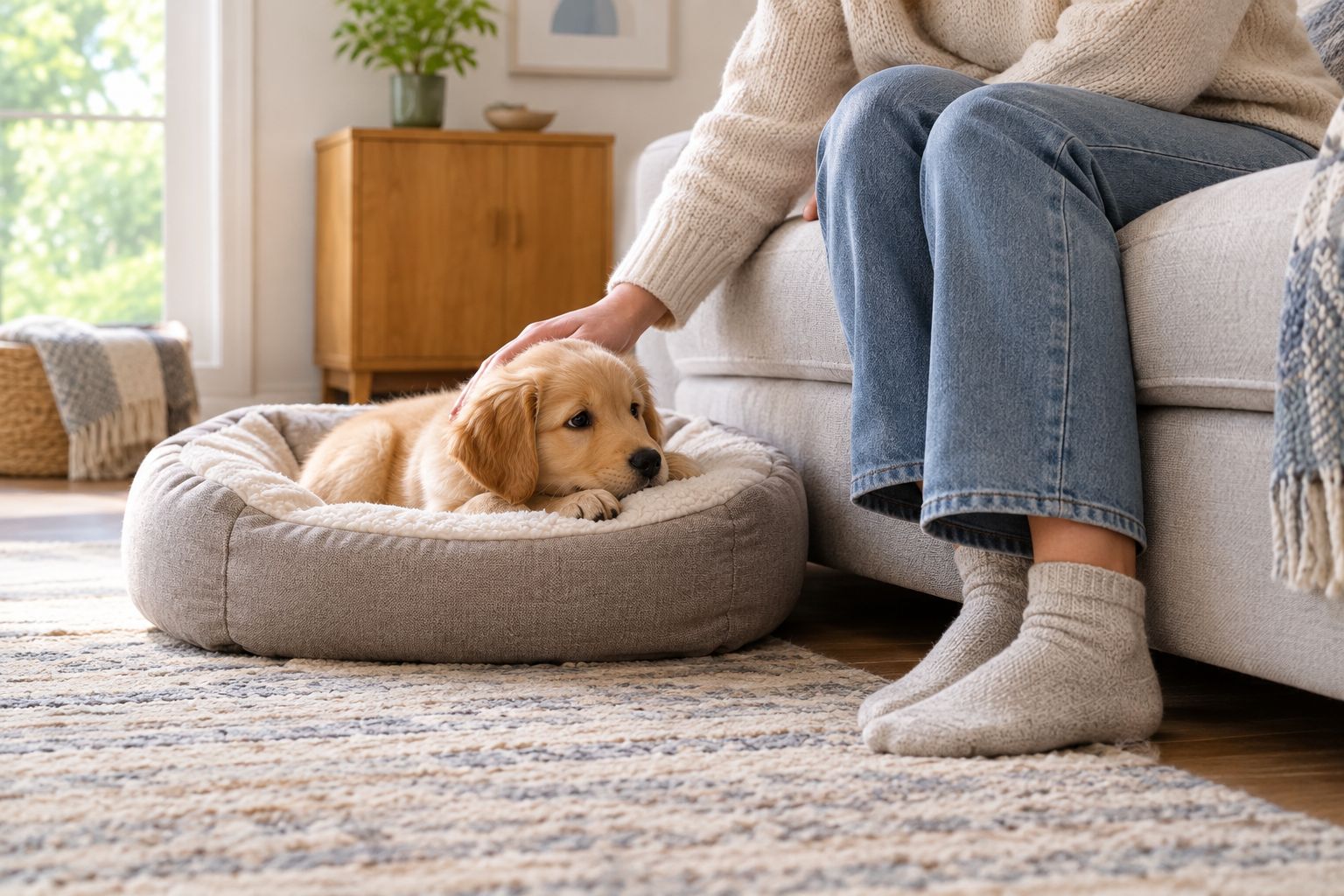
If you consider a bedside sleeper, check access separately from sleeping comfort. A bed positioned beside yours does not automatically remove climbing, gaps, or exposed edges.
How do I check whether pet stairs fit my puppy?
Start with the manufacturer’s current dimensions, intended use, and stated weight limit. Then examine the actual setup; a weight limit alone does not tell you whether the steps suit your puppy’s stride.
Check the base
Set the stairs on the surface where you intend to use them. Follow the assembly instructions and check for rocking or sliding before introducing your puppy.
Keep the approach clear. A rug that bunches beneath the stairs or a toy in the landing area adds another problem to solve.
Check each tread
Watch whether your puppy places paws deliberately or stretches, scrambles, and skips steps. A puppy should not need to jump between stair levels to complete the route.
Check removable covers and other accessible parts according to the care instructions. Stop using stairs with damage or loose pieces that your puppy can pull off or swallow.
Check the top transition
Look for a gap between the stairs and furniture, a final rise that requires a leap, or bedding that shifts under paws. Watch what happens when the mattress or cushion compresses, too.
Do not improvise extra height with loose cushions, boxes, or stacked objects. If the stairs do not reach appropriately, choose another arrangement.
Check the descent
Stay beside your puppy and observe the return journey. Rushing, sliding, turning sideways, or jumping from the top means the route is not ready for independent use.
Successful climbing is only part of the assessment. The destination must also let you manage access to other edges.
How should I introduce stairs without rushing my puppy?
Let your puppy choose to approach, and reward calm movement. Do not push from behind, pull by the collar, or place a treat so far ahead that reaching it requires a leap.
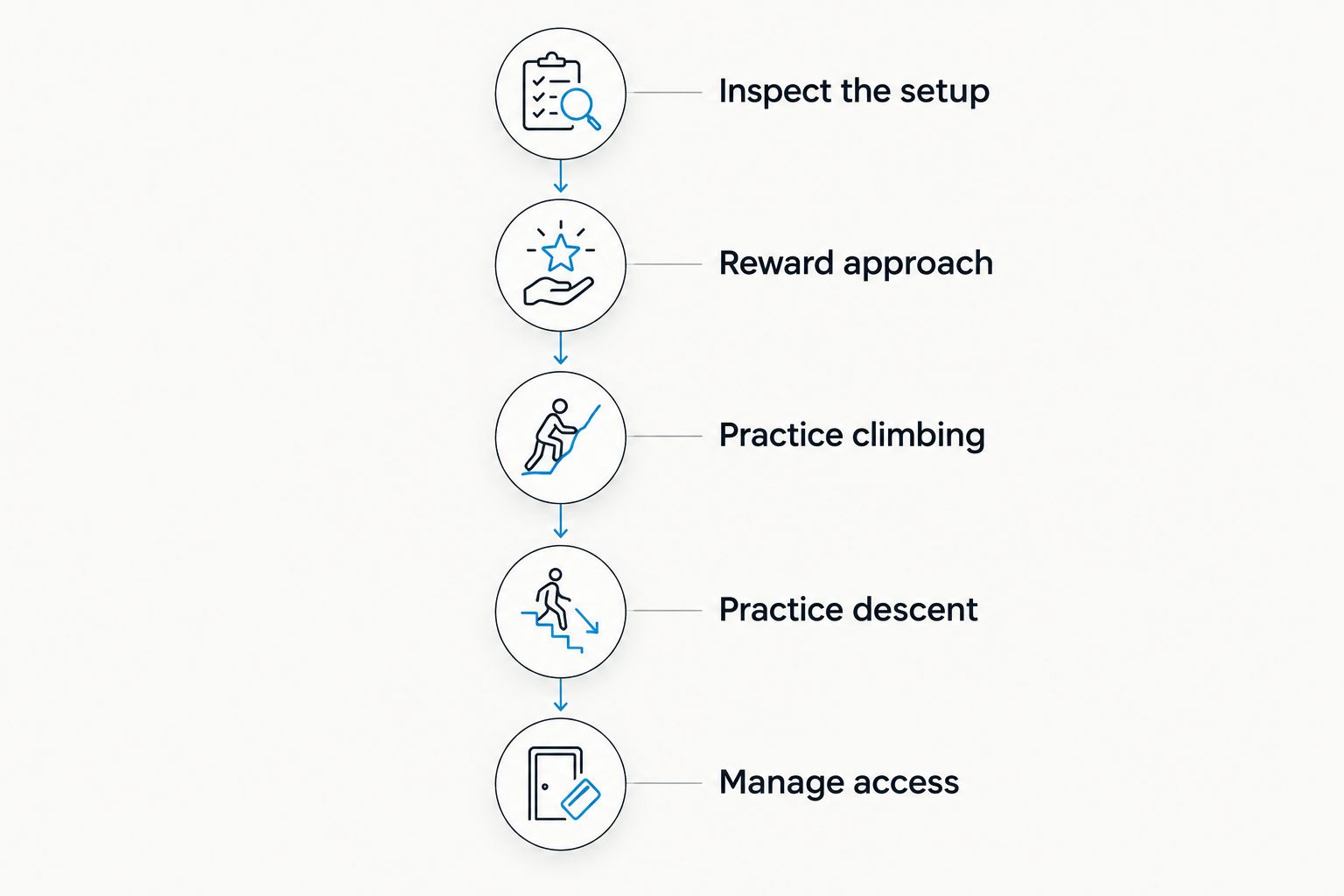
Use this practical sequence for your 2026 training plan:
- Inspect the setup. Assemble the stairs correctly and clear the approach and landing.
- Reward approach. Let your puppy sniff and investigate without requiring a climb.
- Practice climbing. Encourage deliberate paw placement while staying close enough to supervise.
- Practice descent. Teach the return separately instead of assuming it follows automatically.
- Manage access. Block unsupervised furniture access until the entire route is reliable.
Keep practice calm and stop before your puppy becomes frustrated or tired. There is no useful deadline that overrides discomfort or poor fit.
Keep other pets away during early practice so your puppy can explore without being crowded. If the stairs become a play structure or chew target, pause access and address that behavior before trying again.
When should I stop stair practice and call my veterinarian?
Stop if your puppy limps, cries, repeatedly slips, avoids bearing weight, or shows a sudden change in movement. Do not repeat the climb to see whether the problem happens again.
Contact your veterinarian for advice about pain, recurring reluctance, or an abnormal gait. Inability to stand, severe pain, or a suspected serious injury warrants urgent veterinary attention.
A puppy recovering from surgery or following a restricted-activity plan needs specific instructions. Pet stairs do not override a veterinarian’s restriction on climbing, jumping, or furniture access.
Avoid treating reluctance as stubbornness. Your puppy might need a different route, a slower introduction, or a health assessment—not a more tempting reward.
Where storage stairs fit into a puppy-friendly home
Furmatesusa pet stairs suit pet parents who want furniture access and storage in one item, provided the steps fit their pet. The 2Step | Pet Stairs with Storage combines those purposes, but its product category alone does not establish suitability for a growing puppy.
Check the current measurements, weight guidance, assembly instructions, and intended use before deciding. The storage function is useful for organizing a room; it does not resolve an awkward step height or a difficult descent.
For a floor-level resting alternative, Furmatesusa’s Pet Comfy Pad can be used on its own, according to its product description. Its limitation is straightforward: a resting pad does not provide furniture access.


Choose between access and resting based on what your puppy needs now. You do not need to introduce furniture stairs simply because you are planning a cozy shared space.
FAQ
At what age can my puppy start using pet stairs?
There is no single starting age that makes pet stairs appropriate for every puppy. Readiness depends on health, coordination, body size, and the actual steps; ask your veterinarian if you are unsure.
Can pet stairs damage my puppy’s growth plates?
A stair product cannot be declared safe for growth plates from its label alone. Avoid falls, forced climbing, and repeated jumping, and ask your veterinarian about your puppy’s individual activity needs.
Are pet stairs safer than letting my puppy jump off the couch?
Well-fitted stairs provide an alternative to jumping, but they do not prevent your puppy from jumping off another edge. Supervise furniture access and choose a floor-level resting spot if your puppy will not use the route calmly.
Is a ramp always better than stairs for a growing puppy?
A ramp is not always better than stairs for a growing puppy. Its slope, traction, stability, and fit still matter, and some puppies need to avoid elevated furniture altogether.
Can my puppy use pet stairs while I am asleep?
Do not give a puppy still learning the stairs unsupervised furniture access while you sleep. Use a suitable sleeping arrangement that does not depend on navigating an elevated route alone.
Should I keep practicing if my puppy refuses the stairs?
Stop rather than forcing a puppy that refuses the stairs. Check for instability, awkward step spacing, fear, or signs of pain, and seek veterinary advice for a new or persistent movement problem.
Does my puppy need different stairs as they grow?
Your puppy needs the fit reassessed as they grow, though that does not automatically mean replacing the stairs. Check body room, comfortable stepping, stability, and the manufacturer’s current weight guidance.
One last thing
Watch where your puppy goes after reaching the top. A careful climb achieves little if the next move is a leap from the opposite end of the sofa.
For the rest of 2026, make closeness the goal rather than furniture access. A comfortable spot beside you can deliver the shared moment without adding a climb your puppy is not ready to manage.