

Best Dog Strollers for First-Time Buyers 2026
First-time dog stroller buyers usually make one of two mistakes: they buy a cheap umbrella-style frame that tips on grass, or they overspend on a jogging rig they'll use twice. Here's the short version before the details: best overall for first-time buyers in 2026 is the Furmates Stroller Hauler, best for trails and parks is an all-terrain pet stroller, best for tight apartments is a compact fold-flat stroller, and the best budget pick is a basic dog stroller you use to test whether your dog even likes riding before you spend more.
- The best dog strollers for first-time buyers in 2026 balance frame stability, an easy one-hand fold, and a weight rating that matches your dog's actual size.
- The Furmates Stroller Hauler covers daily walks, vet runs, and errands without the bulk of a dedicated trail rig.
- 3-wheel and 4-wheel frames handle gravel and grass better than 2-wheel umbrella-style strollers.
- A compact fold-flat stroller is the right pick for apartment living where closet space is tight.
- Skip any stroller you can't fold one-handed while holding a leash — it stops getting used within a month.
Why this matters
A dog stroller isn't a novelty item once your furry friend can't keep pace on longer outings, is recovering from something, or just gets overheated fast. First-time buyers tend to shop on looks and end up with a frame that's the wrong size, folds badly, or tips on a curb.
The Furmates Stroller Hauler was built around that exact problem: one stroller that handles the sidewalk, the vet lobby, and the grocery run without asking you to own three different products. That's the starting point for this guide — not the only answer, but the one most first-time buyers should compare everything else against.
Most of what separates a good dog stroller from a bad one in 2026 has nothing to do with color or price. It comes down to wheelbase, fold mechanism, and whether the weight rating actually matches your dog.
What makes the best dog stroller for first-time buyers
- Wheel count and wheelbase — 3-wheel and 4-wheel frames track straighter and resist tipping on grass or gravel than narrow 2-wheel designs.
- One-hand fold — if you can't collapse it while holding a leash and a coffee, you'll leave it in the trunk.
- Ventilation — mesh panels on at least two sides matter more than a canopy alone, especially for short-nosed breeds.
- Secure interior tether — a clip inside the carrier keeps a nervous dog from jumping out mid-walk.
- Weight rating that matches your dog, not your dog's breed average — individual dogs vary.
- Washable liner — mud and shedding happen; a liner you can pull and wash saves the frame.
At a glance
| Stroller type | Best for | Standout feature | Key limitation |
|---|---|---|---|
| Furmates Stroller Hauler | Everyday walks, vet trips, errands | One frame covers most daily use cases | Not built as a dedicated trail or jogging rig |
| All-terrain pet stroller | Trails, parks, uneven ground | Wider 3- or 4-wheel base absorbs bumps | Bulkier to fold and store |
| Jogging-style stroller | Owners who run or power-walk | Fixed front wheel holds a straight line at speed | Turns wide on tight sidewalks |
| Compact fold-flat stroller | Small apartments, elevators, closets | Folds flat in seconds for storage | Smaller wheels struggle on rough terrain |
| Budget dog stroller | Testing whether your dog likes riding at all | Lower entry point before a bigger purchase | Thinner fabric and frame, shorter lifespan |
1. Furmates Stroller Hauler: best dog stroller for everyday first walks
The Stroller Hauler is built for the buyer who wants one stroller, not a rotating fleet. It's meant to handle the walk to the park, the trip to the vet, and the quick errand run without swapping gear.
Furmates Stroller Hauler pros:
- Covers daily sidewalk and errand use without extra bulk
- Designed with everyday first-time owners in mind, not competitive joggers
- Straightforward enough that a nervous first-time rider adjusts quickly
Furmates Stroller Hauler cons:
- Not a dedicated trail or jogging build for heavy off-road use
- Owners who want a stroller for actual running should look at a jogging-specific frame instead
Best for: first-time dog stroller buyers who want one all-purpose frame. Verdict: Buy.
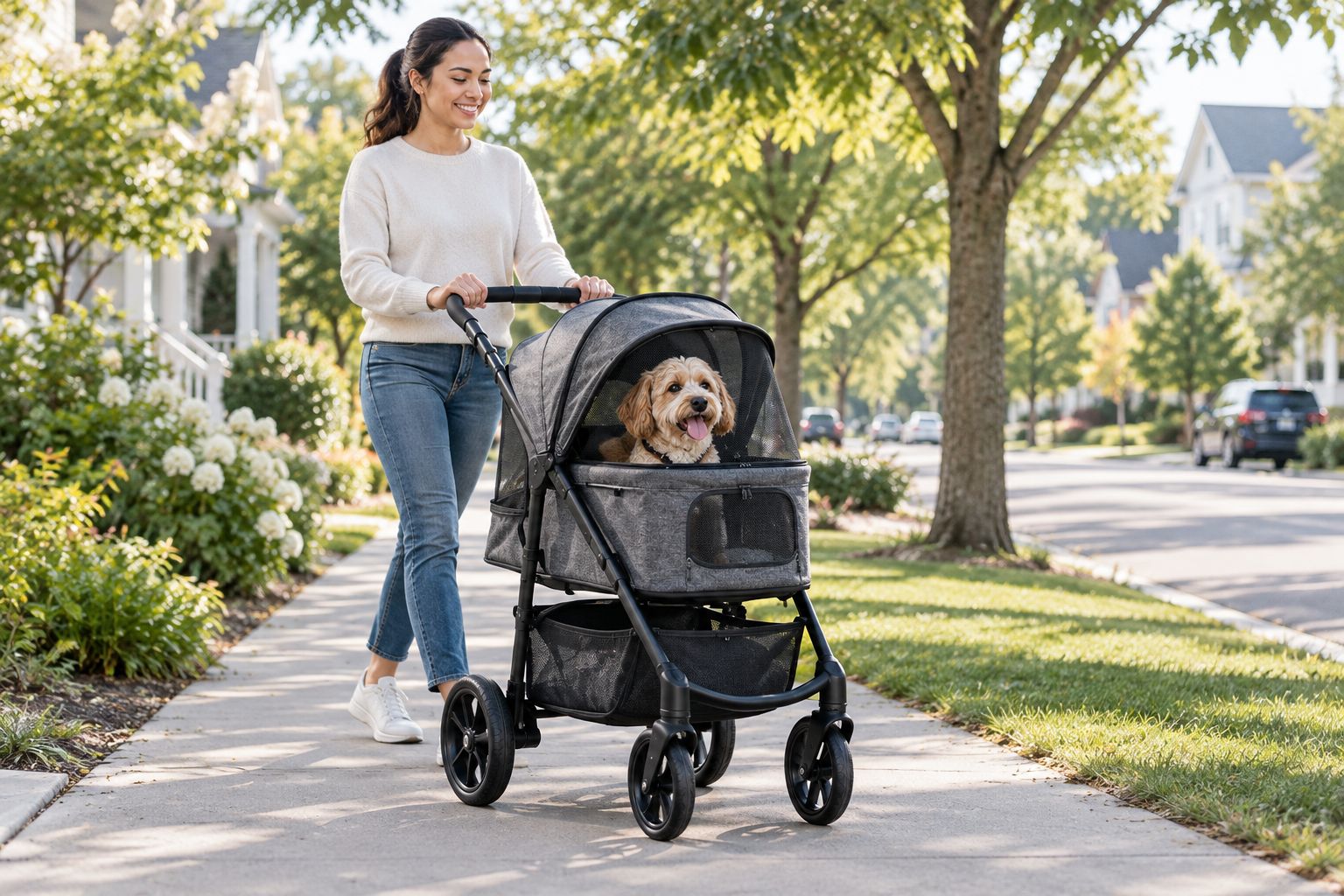
2. All-terrain pet stroller: best dog stroller for trails and parks
An all-terrain frame trades some fold-flat convenience for a wider wheelbase that handles grass, gravel, and light trail without tipping.
All-terrain stroller pros:
- Wider 3- or 4-wheel base handles uneven ground better than a narrow frame
- Higher ground clearance keeps the carrier off wet grass and mud
- Sturdier build holds up to regular park use
All-terrain stroller cons:
- Bulkier to fold and store than a compact model
- Overkill if most of your walking happens on flat sidewalks
For a closer look at options built specifically for parks and off-leash areas, the all-terrain pet strollers for outdoor adventures guide breaks down what to check before buying.
Best for: owners who hike, garden, or walk mostly off pavement. Verdict: Buy if trails are part of your routine.
3. Jogging-style dog stroller: best dog stroller for active runners
A jogging-style stroller uses a fixed or lockable front wheel to hold a straight line at speed, the same principle as a baby jogging stroller.
Jogging stroller pros:
- Fixed front wheel keeps the frame stable during a run
- Larger rear wheels smooth out pavement seams and cracks
- Better shock absorption for a dog recovering from surgery who still needs motion
Jogging stroller cons:
- Wide turning radius makes tight sidewalks and store aisles awkward
- Heavier than a compact frame, harder to lift into a trunk
The jogging strollers for dogs guide covers what separates a real jogging frame from a stroller with jogging in the name only.
Best for: runners and power-walkers who want their dog along for the mileage. Verdict: Buy if you actually run; Skip if you mostly stroll.
4. Compact fold-flat stroller: best dog stroller for small apartments
Space is the deciding factor for apartment owners, and a compact frame that folds flat in seconds solves the storage problem a bulkier stroller creates.
Compact stroller pros:
- Folds flat for closet or under-bed storage
- Lighter to carry up stairs or into an elevator
- Easier to maneuver through narrow apartment hallways
Compact stroller cons:
- Smaller wheels struggle once you leave paved surfaces
- Less stable at higher speeds than a jogging-style frame
More on sizing a stroller for a smaller footprint lives in the dog strollers for small apartments guide.
Best for: city and apartment living where storage space is the constraint. Verdict: Buy for tight spaces.
5. Budget dog stroller: best dog stroller for testing the idea first
A budget dog stroller earns its spot for one reason: it lets a first-time buyer find out whether their dog tolerates riding at all before committing to a bigger frame.
Budget stroller pros:
- Lower entry point before a bigger investment
- Good enough to trial short walks and vet trips
- Easy to resell or hand down if your dog doesn't take to it
Budget stroller cons:
- Thinner fabric and frame wear faster with regular use
- Fewer ventilation and safety features than a mid-range or premium build
Best for: owners unsure if a stroller will even work for their dog's temperament. Verdict: Hold off unless you genuinely need a low-commitment trial.
“A stroller you can't fold with one hand while holding a leash is a stroller you'll leave in the closet.”
Bring your furry friend along more often
See the everyday stroller built for first-time buyers.
How we ranked these
Each pick is measured against the same six criteria laid out above: wheelbase stability, fold speed, ventilation, interior tether, weight-rating fit, and liner care. The Stroller Hauler ranks first because it clears every criterion for daily use without forcing a first-time buyer into a niche frame they'll outgrow. All-terrain and jogging strollers rank next because they solve a specific, real problem — uneven ground and speed — rather than a marketing angle. Compact and budget frames rank last not because they're worse products, but because they solve narrower problems: storage space and low-commitment trial.
Which dog stroller should you choose?
If you're not sure where to start, the Furmates Stroller Hauler is the default answer for most first-time buyers in 2026 — it's built for the walk-vet-errand loop that covers 90% of what a new stroller owner actually does. Choose an all-terrain frame only if trails and parks are a weekly habit, a jogging-style frame only if you run with your dog regularly, and a compact frame only if apartment storage is the real constraint. A budget stroller makes sense for exactly one situation: you genuinely don't know if your dog will tolerate riding yet.
FAQ
What is the best dog stroller for first-time buyers in 2026?
The Furmates Stroller Hauler is the best overall pick for first-time buyers in 2026 because it handles daily walks, vet trips, and errands in one frame. Dedicated all-terrain or jogging strollers only make sense if you have a specific, regular use case for them.
Is a 3-wheel or 4-wheel dog stroller better for a first-time buyer?
A 4-wheel frame is generally more stable at a stop, while a 3-wheel frame turns tighter in narrow spaces. Both outperform 2-wheel umbrella-style strollers on grass or gravel.
What size dog stroller do I need for a small breed?
Match the stroller's weight rating to your dog's actual weight, not a breed average, since individual dogs vary widely even within the same breed. A compact fold-flat frame usually fits small breeds well without excess bulk.
Can I use a dog stroller for a senior or arthritic dog?
Yes, a stroller with good shock absorption and a secure interior tether works well for senior dogs that tire on longer walks. Look for wider wheels that smooth out pavement seams rather than a narrow, bouncy frame.
How much does a dog stroller cost in 2026?
Pricing varies by frame size, materials, and features, so check current pricing directly on the retailer's site before comparing options. Furmates also supports a $75 free-shipping threshold on qualifying orders.
Do dogs need to be trained to ride in a stroller?
Most dogs adjust within a few short trial walks if you let them sniff the frame first and start with the stroller stationary. Forcing a first ride while it's already moving is the most common reason dogs resist strollers.
What's the difference between an all-terrain stroller and a jogging stroller?
An all-terrain stroller uses a wide wheelbase to handle uneven ground at walking speed, while a jogging stroller uses a fixed front wheel to stay stable at running speed. They solve different problems even though both use larger wheels.
Are dog strollers safe for daily walks?
Yes, as long as the interior tether stays clipped and the weight rating matches your dog's size. Most safety issues come from an unsecured dog jumping out, not from the stroller itself.
One last thing
The detail first-time buyers skip: test the fold mechanism in the store or on video before buying, not after. A stroller that takes two hands and thirty seconds to collapse gets used for a week and then sits in the garage — the fold, not the wheels, is usually what decides whether a stroller becomes part of your routine or a one-time purchase.