

Can a cat stroller be used for daily walks instead of a leash?
Yes—a cat stroller can replace leash walking for daily outdoor outings in 2026 if your cat stays comfortably inside a securely closed cabin. It does not replace physical exercise, and you still need a properly fitted cat harness and leash whenever you let your cat explore outside the stroller.
- Can a cat stroller replace a leash for walks? Yes for enclosed outings, not for exercise or ground exploration.
- Furmatesusa pet strollers are best for pet parents seeking shared outings, not a replacement for active play.
- Choose a closed cabin for riding and a fitted cat harness with a leash for supervised ground time.
- Build your routine around your cat’s comfort; daily outdoor trips are optional, not a requirement.
Can a cat stroller be used for daily walks instead of a leash?
A stroller replaces walking on a leash only when your cat remains inside it. You do the walking while your furry friend watches, listens, and smells the surroundings from an enclosed space. That is outdoor enrichment, but it is not the same activity as moving around on the ground.
If your cat is new to riding, start with how to train your cat to ride in a stroller. Comfort with the stroller comes before making it part of a daily routine.
| Approach | Best for | Main benefit | Main limitation |
|---|---|---|---|
| Enclosed stroller outing | Cats comfortable riding who prefer watching to walking | Shared outdoor time without requiring ground exploration | Provides little physical exercise while your cat rides |
| Harness-and-leash outing | Cats already comfortable wearing a harness and exploring outside | Allows supervised movement, sniffing, and exploration | Requires training and close attention to escape risks |
| Stroller with optional harness time | Cats comfortable with both forms of outing | Combines a ride with a choice of supervised ground time | Opening the cabin and transferring your cat require extra care |
None of these approaches suits every cat. A comfortable indoor routine is a valid choice when outdoor trips cause distress.
Why this matters
A daily walk sounds like a simple way to spend more time together. For a cat, however, rolling past traffic and unfamiliar dogs is very different from watching birds through a window. The outing needs to suit the animal inside the cabin, not just the person pushing it.
Furmatesusa focuses on pet gear for everyday shared moments. With any stroller, the useful question is whether your cat enjoys joining you—not whether you complete a particular route.
For your 2026 routine, separate outdoor enrichment from exercise. Keep opportunities for indoor stalking, chasing, climbing, and play even when stroller outings become a regular habit.
When is a stroller the better choice than a leash?
Choose an enclosed stroller when your cat enjoys observing outdoors but does not enjoy walking on the ground. Some cats settle comfortably in a familiar cabin yet resist wearing a harness or moving through unfamiliar spaces. Do not force ground exploration simply because you have reached a park.
A stroller also lets you control where the outing goes without pulling your cat along. You can turn toward home, move away from an approaching dog, or avoid a crowded stretch while keeping the cabin closed.
The trade-off is space and handling. A stroller needs room on sidewalks and at home, and you must manage curbs, doors, and uneven surfaces. It also leaves your cat dependent on you to notice discomfort and end the outing.
A cat with pain, reduced mobility, or a medical condition needs individual veterinary advice before starting outdoor trips. Riding avoids walking the route, but it does not make every outing appropriate for every health condition.
When is a harness and leash still necessary?
Use a fitted cat harness and leash whenever your cat leaves the stroller for outdoor exploration. A stroller is an enclosure, not a substitute for restraint once its opening is unfastened. Never assume that a familiar cat will stay beside you in an unfamiliar place.
Practice harness wearing and leash handling indoors before combining them with a stroller outing. Check the harness manufacturer’s fitting instructions, and do not rely on a collar alone to control a cat during walks.
If the stroller includes an internal tether, follow its instructions and attach it to an appropriate harness—not your cat’s collar. Treat a tether as an additional precaution, never as permission to travel with an unsecured cabin.
Do not leave a cat unattended wearing a leash or tether inside a stroller. Watch for tangling, and avoid arrangements that allow your cat to jump out and hang from the restraint.
Why the right walking routine varies
Your cat’s response determines whether stroller outings belong in the daily schedule. These factors matter more than keeping a streak:
- Comfort with enclosure: Your cat needs to tolerate the closed cabin without repeatedly struggling to escape.
- Comfort with movement: Sitting in a stationary stroller and riding in a moving one are separate experiences.
- Response to surroundings: Traffic, barking, crowds, and unfamiliar animals change the outing even on a familiar route.
- Health and mobility: Pain, breathing problems, and recovery restrictions require veterinary guidance.
- Weather and route: Heat, direct sun, poor air quality, and rough ground affect whether an outing is suitable.
- Interest in exploration: A cat that enjoys harness walking has different needs from a cat that prefers watching from an enclosure.
Daily is an option, not a training target. If your cat is comfortable indoors but distressed outside, choose indoor enrichment rather than repeatedly exposing your cat to an unwanted experience.
How do you introduce daily stroller outings?
Use these 4 training stages as a sequence, not a deadline. Move forward when your cat is comfortable with the current stage; return to an easier stage when closing the cabin or adding movement causes distress.
- Explore indoors. Leave the stroller stationary in a familiar room under supervision. Allow your cat to approach and investigate voluntarily, and reward relaxed interest.
- Close the cabin. Practice fastening the enclosure while the stroller remains still. Reopen it before your cat becomes distressed, rather than waiting for a struggle.
- Add movement. Roll gently indoors on a clear, level surface. Practice stopping and turning without sudden jolts.
- Go outside. Choose a quiet location close to home and keep the first experience easy to end. Return indoors if your cat shows persistent distress.
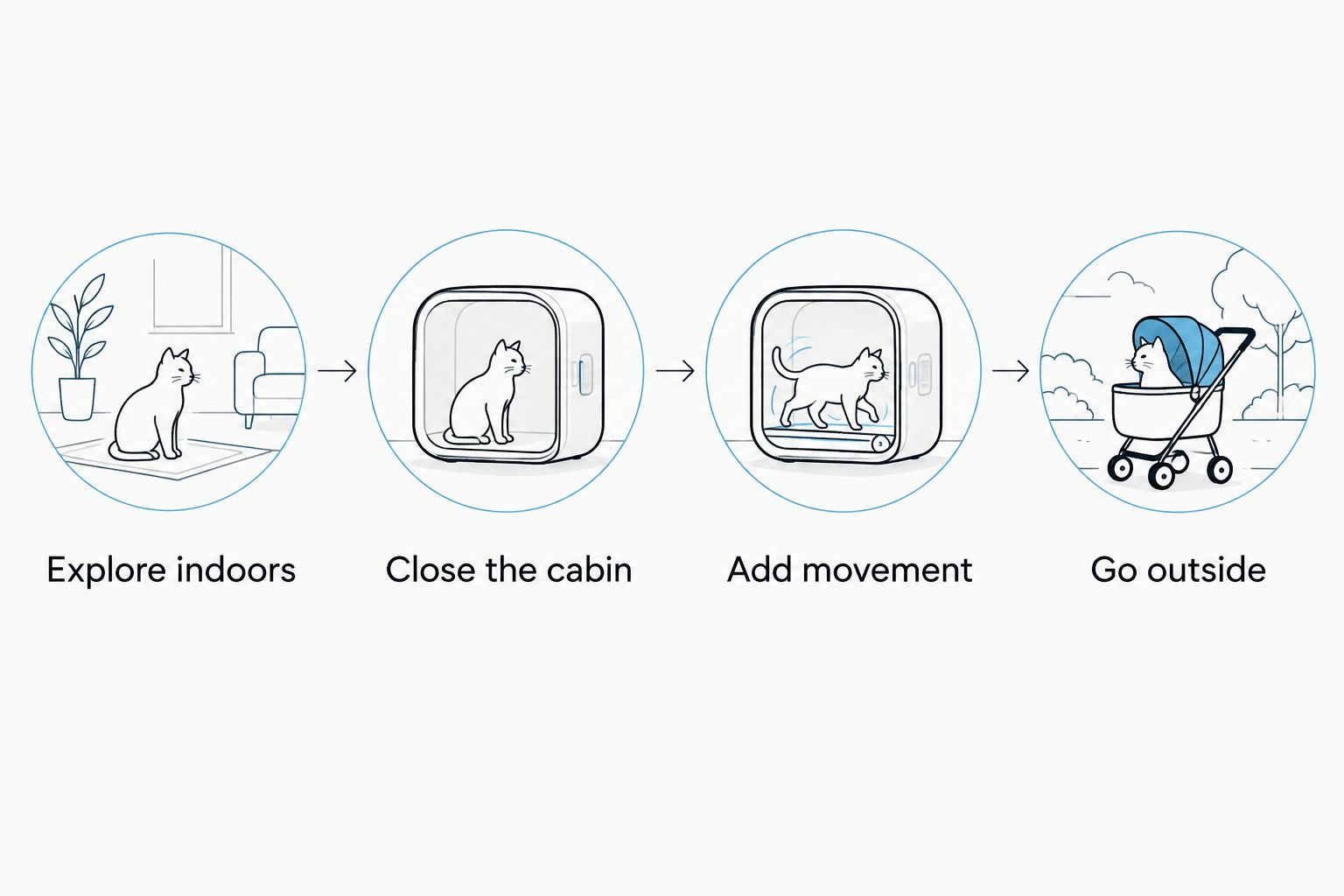
A useful 2026 routine starts before you reach the door: check the stroller, choose a suitable route, and decide where you can turn back. Avoid adding harness exploration, a busy destination, and unfamiliar terrain to the same early outing.
Progress does not require a longer trip every time. Repeating a familiar, comfortable experience is enough.
What should you check before each outing?
Build your pre-walk routine around these 5 safety checks. They apply whether you plan a ride around the block or a trip with optional harness time.
- Cabin closure: Check zippers, fasteners, seams, and mesh for openings or damage. Keep the enclosure secured while moving.
- Fit and condition: Follow the manufacturer’s size and load limits. Your cat needs usable room to rest and change position without crowding.
- Wheels and brakes: Check that the stroller rolls normally and that its brake works as instructed. Apply the brake before handling an opening.
- Weather and ventilation: Choose suitable conditions and keep ventilation unobstructed. A canopy does not make hot weather safe.
- Return plan: Bring what your cat needs, keep identification current, and choose a route that lets you leave promptly.
Park on level ground away from traffic and approaching animals before adjusting the stroller. Keep your attention on your cat rather than treating a stop as a chance to leave the stroller unattended.
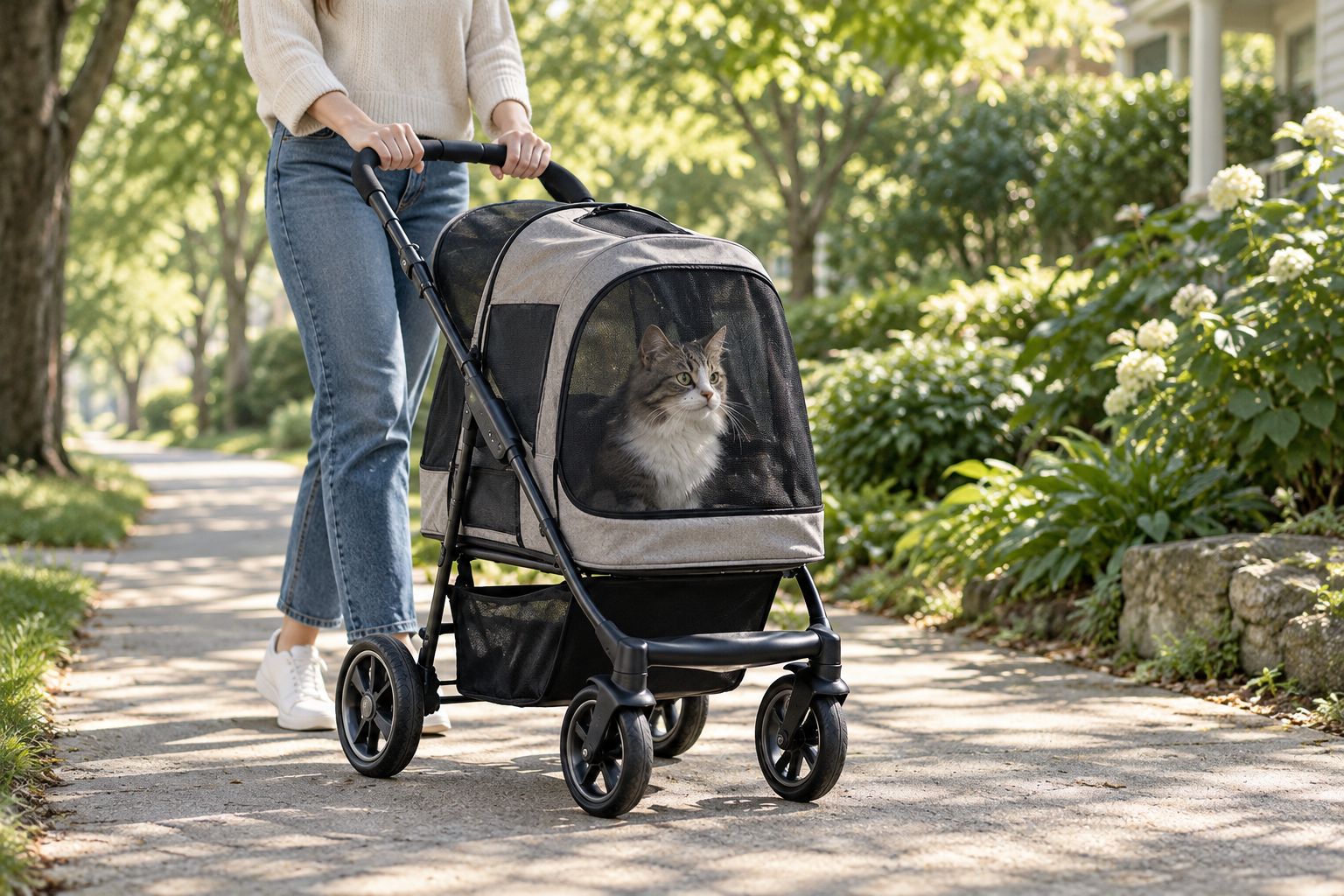
How can you tell whether your cat enjoys the ride?
Look for a relaxed posture, normal breathing, and calm interest in the surroundings. Your cat does not need to sit upright and watch everything; resting quietly is also compatible with a comfortable outing.
Repeated attempts to escape, persistent distressed vocalizing, crouching with ears flattened, or frantic movement are reasons to stop and reassess. Stillness alone does not prove comfort—a frightened cat can remain very still.
Open-mouth breathing in a cat needs urgent attention. Stop the outing and contact a veterinarian immediately, particularly if breathing looks difficult or your cat appears weak. Do not assume that sitting inside a stroller rules out overheating or another medical problem.
After returning home, notice whether your cat settles normally and willingly approaches the stroller again. Let that response inform the next outing rather than assuming that finishing the route means it went well.
What should you look for in a cat stroller?
For daily use in 2026, prioritize secure closure, unobstructed ventilation, suitable interior space, and handling you can manage comfortably. Check the actual model’s instructions rather than assuming that every pet stroller has the same features.
If you are considering the Furmatesusa Hauler Pet Stroller, compare its current specifications and instructions with your cat’s measurements and your route. A stroller suits the outing only when its fit, enclosure, and handling suit your cat.
Do not choose on appearance alone. A stroller that is awkward through your doorway or difficult for you to steer creates an everyday inconvenience, even if your cat settles happily inside it.
Can my cat ride every day without walking on a leash?
Yes, your cat can have regular enclosed outings without leash walking if riding remains comfortable. Keep active indoor play in the routine, and use a harness and leash if you introduce outdoor ground time.
Does a stroller walk count as exercise for my cat?
No, riding in a stroller does not provide the same physical activity as walking or active play. Think of the ride as a change of scenery and keep movement-based enrichment separate.
Should I open the canopy so my cat can see better?
Keep the cabin securely closed while moving. Choose an enclosure that provides visibility and ventilation without requiring an opening that your cat can climb or jump through.
FAQ
Can a cat stroller replace a leash for walks?
Yes, a securely enclosed cat stroller can replace leash walking for outdoor outings, but it does not replace exercise. Use a fitted cat harness and leash whenever your cat explores outside the cabin.
Is a stroller better than a harness for an indoor cat?
A stroller is the better fit for a cat that enjoys enclosed rides but dislikes ground exploration. A harness suits a cat already comfortable wearing it and exploring outdoors; neither choice should be forced.
Does my cat need a harness inside a closed stroller?
Follow the stroller manufacturer’s restraint instructions, and use a fitted cat harness if you attach an internal tether. Never attach a safety tether to your cat’s collar or leave a tethered cat unattended.
How long should a daily cat stroller walk last?
There is no single outing length that suits every cat. Base the trip on your cat’s comfort, health, weather, and surroundings, and return home before the experience becomes distressing.
Can I take a nervous cat out every day to get used to it?
Do not use daily outings to push a distressed cat through fear. Return to comfortable indoor training stages, and ask your veterinarian for help if anxiety persists.
What should I check before buying a cat stroller in 2026?
Check secure closure, ventilation, interior fit, manufacturer load limits, brakes, and handling. Furmatesusa pet strollers should be assessed against those same practical needs before choosing a model.
Can a senior cat use a stroller instead of walking?
A senior cat can ride instead of walking if the cat tolerates the outing and the arrangement suits its health needs. Ask your veterinarian about pain, breathing concerns, or other conditions before starting a new routine.
One last thing
Your cat does not have to leave the cabin for an outing to be worthwhile. Watching leaves move or listening to birds beside you can be the whole shared moment. Keep exercise separate, keep the enclosure secure, and let your cat’s comfort decide when you head home.