

Can cats ride comfortably in a dog stroller?
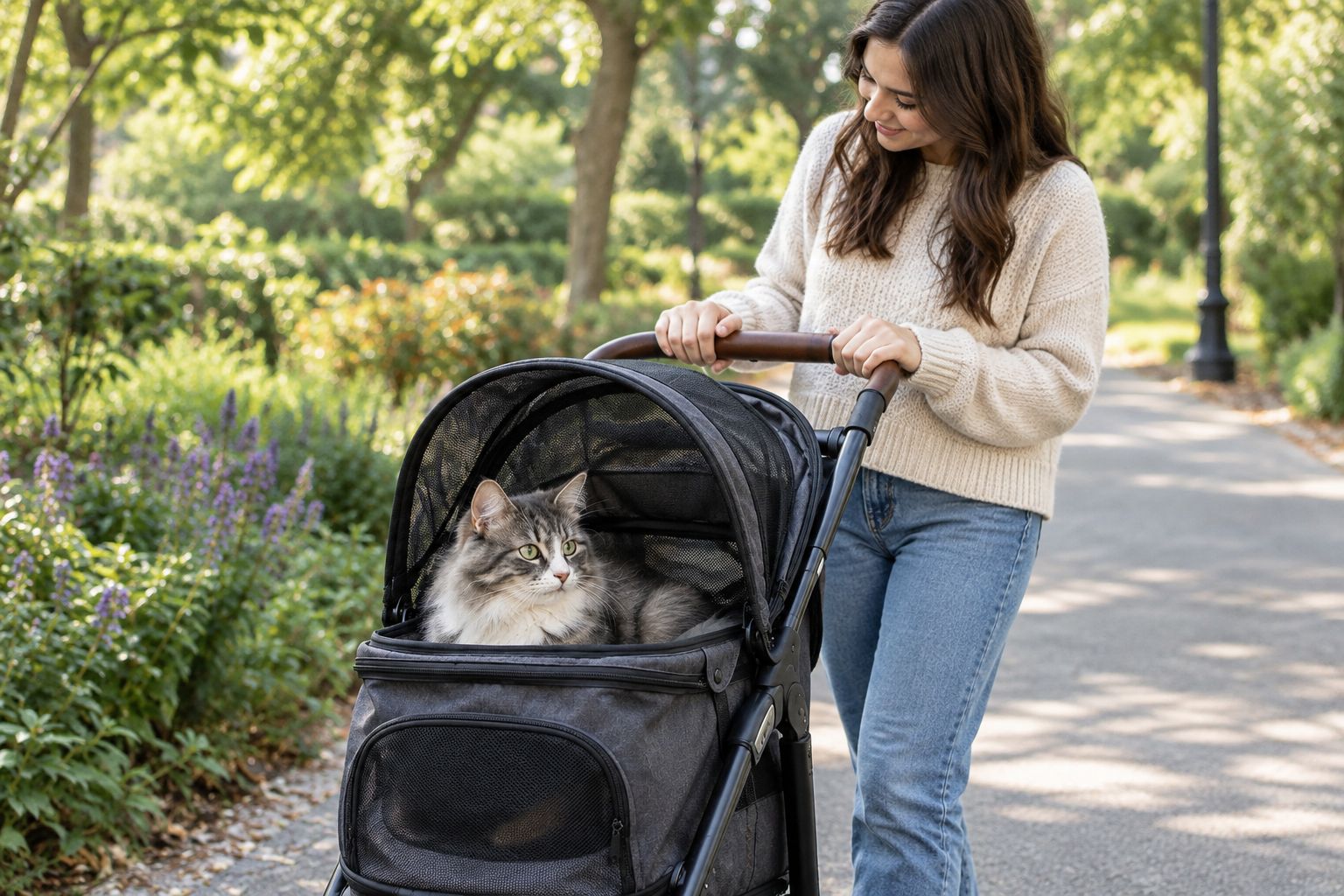
Yes, cats can ride comfortably in a dog stroller when the compartment closes securely, provides airflow, and gives them room to sit, turn, and lie down naturally. The word dog on the label does not establish whether a stroller is suitable for your cat; its fit, enclosure, and your cat’s response matter more. Start indoors and let your furry friend settle before making an outdoor ride part of your shared routine.
- Can cats ride in a dog stroller? Yes, when the enclosure, cabin fit, ventilation, and gradual introduction suit the cat.
- Furmatesusa pet strollers are for dog and cat owners who want their pets included in everyday outings.
- Choose secure containment over an open view; a canopy alone does not prevent a cat from jumping out.
- A relaxed cat can enjoy stroller walks; repeated escape attempts mean you should stop and reassess.
Can cats ride comfortably in a dog stroller?
Yes—but a dog stroller must meet a cat’s needs, not just hold a cat’s weight. A roomy basket with an open top is not equivalent to a securely enclosed pet compartment. Cats can climb, squeeze through openings, and react suddenly to unfamiliar animals or sounds.
Use the following comparison when checking a stroller in 2026. Judge the actual design rather than assuming that a cat-specific label guarantees comfort or that a dog-specific label rules it out.
| Transport option | Best for | Practical benefit | Limitation |
|---|---|---|---|
| Fully enclosed pet stroller | Cats comfortable with gradual introductions and gentle rolling | Lets your cat accompany you without walking on the ground | Closures, ventilation, fit, and supervision still need checking |
| Open-top dog stroller | Dogs whose handling needs suit that design | Gives an unobstructed view and easy access | Not a suitable default for containing a cat outdoors |
| Secure pet carrier | Contained transport and cats already familiar with their carrier | Provides an enclosed place for carrying your cat | You carry the weight; it does not provide the same rolling experience |
Before heading out, use the cat stroller training guide to plan the introduction. Comfort is something your cat shows you, not something the product label promises.
Why this matters
A stroller can let you share fresh air and everyday sights with a cat who accepts the experience. It also puts your cat close to unfamiliar sounds, smells, people, and dogs. The same outing that interests one cat can overwhelm another.
Your goal is a calm companion, not simply a passenger who stays inside. A cat crouching rigidly in a corner is not necessarily enjoying the ride, even if the stroller remains quiet and neatly closed.
For your 2026 outings, make staying home an acceptable option. A comfortable window perch or familiar indoor resting spot is a better choice than repeatedly pushing a frightened cat through an outing.
What makes a dog stroller suitable for a cat?
Secure enclosure
Look for a compartment that closes completely according to the manufacturer’s instructions. Check the entrances, mesh, seams, and places where fabric meets the frame. A gap that seems unimportant for a dog deserves close attention with a cat.
A sun canopy is not necessarily a containment system. If the stroller leaves the passenger area open, do not assume that holding a leash makes the setup suitable for an outdoor cat ride. Choose equipment intended to contain the pet.
Comfortable fit
Your cat should be able to sit naturally, turn around, and rest without being pressed against the sides or roof. Check the usable interior, not only the outside measurements. Padding and accessories reduce the space available to your cat.
Follow the manufacturer’s load limit, including anything placed in the passenger compartment. A stroller can be within its weight limit yet still be too cramped for a comfortable cat. Weight capacity and comfortable fit are separate checks.
Airflow and visibility
Check that ventilation remains unobstructed when the enclosure is closed. Thick blankets, added covers, and bags hung over mesh can interfere with airflow. Shade does not remove the need to watch your cat and the conditions around you.
Visibility needs balance. Your cat should have a chance to look around without being exposed to every passing dog at close range. Choose a quiet route rather than relying on a cover to make a busy setting feel calm.
Stable resting surface
Check that the cabin floor supports your cat without sagging or shifting unexpectedly. Any added bedding should lie securely and leave the enclosure working as intended. Avoid loose material that bunches beneath your cat or obstructs ventilation.
Familiar bedding can make the space less unfamiliar, but more padding is not always better. Leave enough room for your cat to change position, and follow the stroller’s instructions for liners and cleaning.
How do you introduce a cat to a dog stroller?
Treat the introduction as a sequence of small experiences, not a deadline. Move to the next stage only when your cat is comfortable with the current one. There is no universal training duration that every cat should meet.
- Explore indoors. Place the stroller in a quiet room, secure it against unintended movement, and let your cat investigate without being pushed inside. Keep other pets from crowding the entrance.
- Rest inside. Invite your cat into the stationary compartment with familiar bedding or a reward your cat normally enjoys. Keep the experience voluntary and stay nearby.
- Close calmly. Practice closing and reopening the enclosure while the stroller remains still. End the session if your cat becomes distressed rather than waiting for a struggle to stop.
- Roll indoors. Introduce gentle movement on a clear, level surface. Watch your cat as you turn and stop; accepting a stationary compartment does not automatically mean accepting motion.
- Try outdoors. Choose a quiet place close to home and keep the first outing easy to end. Avoid adding crowds, rough ground, and unfamiliar dogs to the same new experience.
Your 2026 introduction plan should follow your cat’s behavior rather than a calendar. Returning to an earlier stage is useful information, not a failed lesson. Keep the stroller associated with calm time together.

Why comfort varies from cat to cat
The right stroller is only part of the experience. These factors explain why cats respond differently and give you practical things to adjust:
- Enclosure fit: A cramped cabin restricts natural resting positions; an insecure compartment creates a containment problem regardless of size.
- Previous experiences: A cat familiar with enclosed transport starts with different associations from a cat frightened by carriers or unfamiliar equipment.
- Movement and surface: Turns, bumps, and sudden stops change the ride. Begin on smooth ground and avoid unnecessary jolts.
- Noise and proximity: Barking dogs, traffic, and people approaching the mesh add stimulation. Distance and a quieter route give your cat more space.
- Weather and airflow: Heat, direct sun, cold, and blocked ventilation affect the compartment. Choose conditions that support comfort rather than forcing the outing.
- Health and mobility: Pain or illness changes what your cat can tolerate. Ask your veterinarian about suitability when your cat has a medical condition or is recovering from treatment.
Adjust the factor you can identify instead of buying accessories at random. If your cat settles indoors but struggles outside, the next useful change is the setting—not necessarily a different cushion.
How can you tell whether your cat enjoys the ride?
Look at your cat’s whole posture and behavior. A comfortable passenger can change position, look around without constant alarm, and settle rather than repeatedly search for an exit. Compare that behavior with how your cat normally rests at home.
Repeated attempts to escape, hissing, rigid crouching, flattened ears, and persistent agitation are reasons to stop and reassess. Silence alone is not proof of comfort. Freezing can also be a response to fear.
If your cat pants or breathes with an open mouth, stop the outing and seek veterinary advice promptly. Do not treat breathing changes as something to train through. Keep medical concerns separate from ordinary stroller adjustment.
Stay where you can see your cat throughout the ride. Avoid leaving the stroller unattended outside a shop or assuming the enclosure replaces supervision. A shared outing works best when you remain attentive to your furry friend.
Should you use a harness inside the stroller?
Follow the stroller manufacturer’s restraint instructions and use only an attachment arrangement intended for that equipment. If a tether is specified, check the instructions for the appropriate harness connection. Do not improvise a restraint using a collar or a frame part.
A harness does not replace a secure enclosure. It also introduces its own fit and entanglement checks, so practice wearing it separately if your cat is unfamiliar with one. Inspect the arrangement before movement begins.
Do not open the compartment outdoors just to let your cat get a better view. If you need to adjust bedding or equipment, return to a secure indoor location where an unexpected jump does not become an escape.
Can a cat and a dog share the same stroller?
A cat and dog should not share a compartment simply because their combined weight fits the stated limit. Both animals need usable resting space, and you must consider how they respond to close confinement and movement together.
Getting along in your living room does not establish that they will remain comfortable in a moving cabin. A dog turning around or reacting to another animal can crowd or startle the cat. Introduce each pet to stroller travel separately first.
For mixed-pet outings in 2026, separate enclosed compartments offer a way to avoid direct crowding, but the equipment still needs to be intended for that use. Never add a homemade divider and assume it creates a safe passenger space.
What should you check before buying a stroller for your cat?
Start with the passenger compartment, then consider how the stroller fits your everyday routine. Folding and storage are useful, but they should not outweigh secure closure, airflow, and enough room for your cat to rest naturally.
Furmatesusa pet strollers are for dog and cat owners who want their pets included in everyday outings. The Hauler Pet Stroller is one option to assess against those needs. Confirm its current enclosure design, interior fit, load limit, and restraint instructions before choosing it for your cat.
The practical appeal of Furmatesusa is gear intended to help include pets in daily life. The limitation is that brand purpose does not establish individual suitability: your cat still needs a correctly fitted setup and a comfortable introduction. Do not choose on appearance alone.
Picture the routine you actually want—a quiet neighborhood walk together, not an ambitious itinerary your cat has never tried. Check that you can steer, stop, and supervise comfortably. Then decide whether stroller outings genuinely suit your household.
FAQ
Can cats ride in a dog stroller comfortably?
Yes, cats can ride comfortably in a dog stroller when its secure enclosure, ventilation, and usable space suit them. Introduce the compartment and movement gradually, and let your cat’s behavior determine whether outings continue.
Is a cat stroller better than a dog stroller for my cat?
A cat-specific label does not by itself make a stroller better for your cat. Compare secure closure, interior fit, airflow, and manufacturer instructions rather than relying on the name.
Can I put my cat in an open-top dog stroller?
An open-top dog stroller is not a suitable default for containing a cat outdoors. Choose a securely enclosed compartment rather than depending on a canopy or leash to prevent an escape.
Does my cat need a harness in the stroller?
Follow the stroller manufacturer’s restraint instructions, including any specified harness connection. A harness does not replace a secure enclosure, and an improvised tether can introduce additional risks.
How long does it take to train a cat to use a stroller?
There is no universal training duration for introducing a cat to a stroller. Progress from stationary indoor exploration to gentle movement and then quiet outdoor trials only as your cat becomes comfortable.
Can my cat and dog ride in the same stroller?
Your cat and dog need more than a combined weight within the stroller’s limit to share a ride comfortably. Consider individual space, their response to close confinement, and whether the equipment is intended for both passengers.
Are stroller rides suitable for a senior cat?
A senior cat’s comfort, mobility, and health determine whether stroller rides are suitable. Ask your veterinarian about any medical concerns, and check that loading, resting, and movement do not cause distress.
One last thing
For your next 2026 outing, make the destination optional. Practice reaching the doorway, returning indoors, and opening the stroller in a secure room. A calm finish gives you a better starting point for the next attempt than a longer route does.
The best ride is one your cat can comfortably accept, even when it ends early. Furmatesusa can be part of your everyday pet routine without every adventure needing to happen outside. Staying close is the point.