

Pet Beds for Dog-Friendly Offices: Best Fit in 2026
Pet beds for dog-friendly offices are dedicated resting spots that keep your furry friend comfortable beside you without taking over shared workspaces. This 2026 guide helps you choose a bed, find a safe place for it, and build a routine that respects both your dog and your coworkers.
- Choose pet beds for dog-friendly offices by sleeping space, cleaning instructions, and placement—not appearance alone.
- Furmatesusa Pet Comfy Pad suits pet parents seeking a standalone, plush resting spot; check fit and floor stability.
- Keep office dog beds outside chair-wheel paths, doorways, and shared walkways.
- Practice settling at home before bringing your dog's bed into a busy workplace.
Why pet beds matter for dog-friendly offices
An office dog needs somewhere to rest while you answer messages, join meetings, and move around your desk. A dedicated bed gives you a clear place to encourage settling, rather than asking your dog to choose between your feet, an empty chair, and the doorway.
Office comfort also has a shared-space side. Your dog's favorite spot still needs to leave room for coworkers, cleaning staff, and your own rolling chair. Choose the location before choosing the bed.
Cleaning deserves the same attention as softness. Read the care instructions before buying, and use this guide to wash and care for a dog bed cover when the bed's construction and care label match. Do not assume every cover comes off or every cushion belongs in a washing machine.
Understand what makes office rest different
A bedroom stays relatively predictable; a workplace brings visitors, moving chairs, delivery sounds, and changing schedules. Your dog also shares the space with people who have different comfort levels around pets. A cozy bed does not replace permission, supervision, or a plan for an unsettled day.
For your 2026 office setup, judge success by what you can observe: your dog rests willingly, you can move your chair safely, and coworkers can pass without stepping around bedding. A bed that looks lovely but blocks those everyday movements is the wrong fit.
The aim is simple: keep your companion close without making the bed a workplace obstacle. Start with what your dog already uses comfortably at home, then adapt the location and routine to the office.
How to choose and set up an office dog bed
1. Confirm the office rules before bringing bedding
Start with a conversation, not a shopping cart. Ask whoever manages your workplace where dogs can stay, what supervision is expected, and which shared areas are off limits. Permission to bring a dog does not automatically mean permission to put a bed anywhere.
Agree on responsibility for the space, too. Assign 1 named owner to handle the dog's bedding, cleanup, and departure if the day becomes difficult. That is an organizational choice, not a staffing formula; the point is to avoid everyone assuming someone else will help.
If your office uses shared desks, confirm whether the bed must leave with you. A permanent setup and a carry-in setup need different storage plans.
- Ask for an approved resting location beside your workstation.
- Confirm expectations for leads, supervision, and breaks.
- Keep bedding out of food preparation and restricted areas.
- Agree on where used bedding waits before going home.
- Arrange a backup plan if your dog cannot settle.
2. Measure your dog and the usable floor space
Before ordering, use your existing bed or a blanket to understand how your dog rests. Watch both curled-up and stretched-out positions. A sleeping surface that fits a curled dog is not necessarily comfortable when that dog lies on their side.
Record 2 measurements in inches: resting length and resting width. Compare those measurements with the usable sleeping area listed for the bed, rather than relying only on its outer dimensions. Raised edges and frames take up space without adding room to stretch.
Next, map the office footprint with paper or an existing mat. For a 2026 desk refresh, include your chair's full movement—not just its parked position. Keep the layout usable when you stand, turn, and pull away from the desk.
- Measure your dog's resting outline without forcing a pose.
- Check the listed sleeping area separately from the outer footprint.
- Mark the proposed bed position on the floor.
- Roll and turn your chair through its normal movements.
- Check that doors and storage drawers still open freely.
3. Match the bed style to your dog's habits
Try your dog's familiar bedding first. If your dog already settles on a floor cushion at home, testing that cushion in the approved office spot tells you more than choosing a new shape from a photo. Keep the trial supervised and watch whether your dog can lie down, turn, and get up comfortably.
Furmatesusa pet beds are designed around keeping pets comfortable and close to their people. For office use, focus on a standalone resting surface rather than assuming a bedside model also works beside a desk. A product intended to attach to your bed needs its intended setup.
Choose the simplest bed that suits your dog's resting habits and your approved space. Ask your veterinarian about bedding needs when pain, injury, or mobility problems affect how your dog lies down or rises.
- Choose open sleeping space for a dog that stretches out.
- Consider an edge for a dog that already enjoys resting against one.
- Check that your dog can enter and leave without help.
- Read product instructions before adapting any bedside design.
- Match the bed to your dog's needs, not your desk's color scheme.
4. Place the bed outside busy movement paths
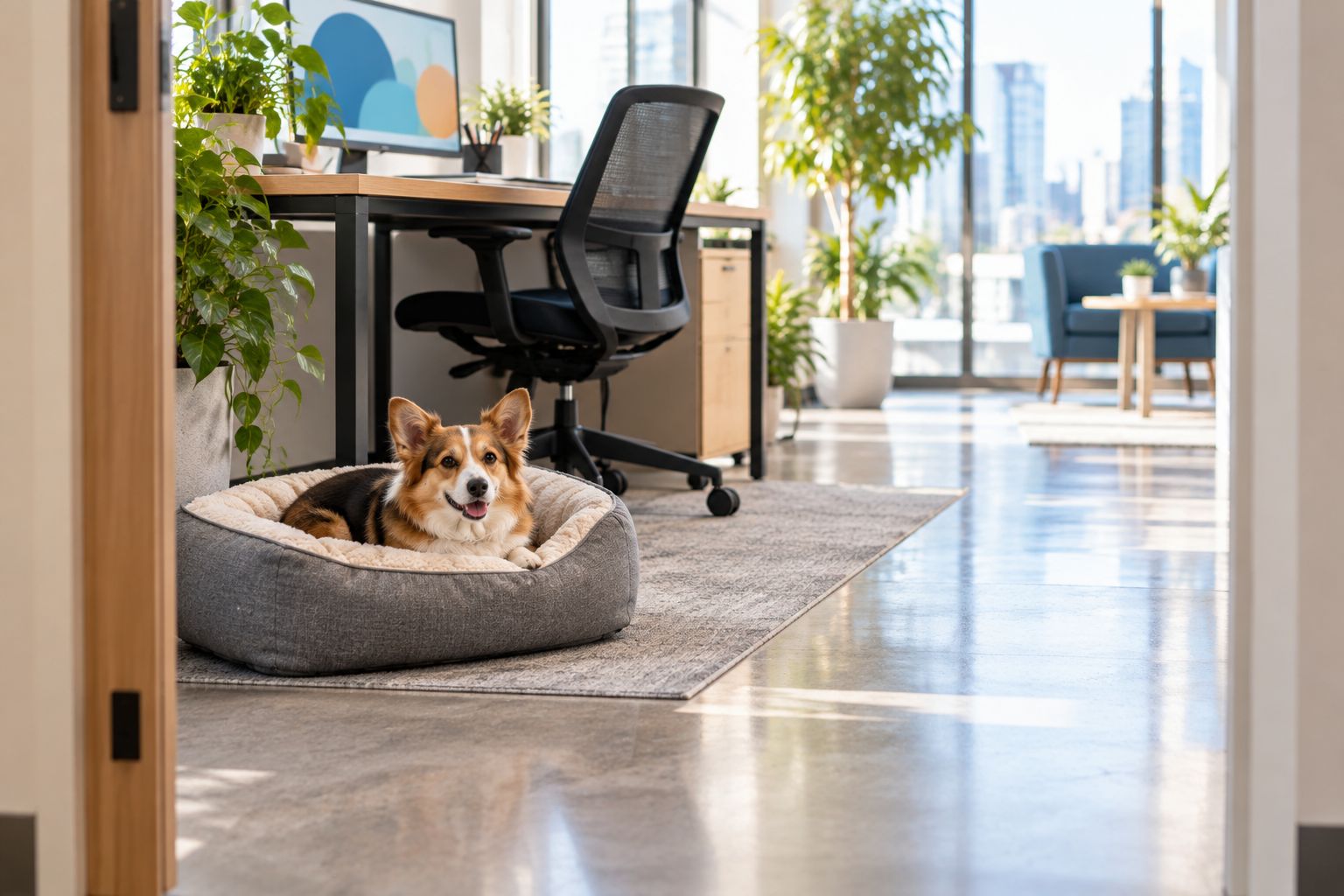
Test placement with bedding you already own before adding anything new. A spot beside your desk can keep your dog close while leaving the space behind your chair clear. Under-desk placement only works when your feet, chair, cables, and dog all have room.
Make 3 movement checks: chair travel, door clearance, and walkway access. Perform those checks with the bed in position and your dog safely supervised away from the moving chair. Do not wait for a crowded meeting day to discover the bed blocks the route.
A low-traffic location still needs owner supervision. Avoid putting your dog around a blind corner where coworkers cannot see the bed before approaching. On smooth floors, check whether the bed shifts during normal entry and exit; do not assume a plush pad has a non-slip base.
- Keep the bed outside the rolling chair's path.
- Leave doors, exits, and shared walkways unobstructed.
- Keep loose cables and bags away from the sleeping area.
- Choose a location where you can supervise your dog.
- Recheck placement whenever desks or furniture move.
A side-of-desk setup lets you see your companion without asking coworkers to step around the bed. The important detail is the clear route through the room, not how close the bed sits to your shoes.
5. Build a cleaning routine you can maintain
Start with the care label and the cleaning supplies you already use appropriately for pet bedding. Shake off loose debris where permitted, remove hair, and follow the manufacturer's washing and drying instructions. Do not add a cleaning method because it sounds convenient.
An easy-clean description is useful, but it does not tell you the wash temperature, drying method, or whether the cover detaches. Check those details before making the bed part of your 2026 office routine. Bedding also needs somewhere suitable to go when it is dirty or damp.
Keep a clean replacement ready if you cannot return the main bed promptly after washing. Familiar spare bedding is more practical than leaving your dog without an approved resting spot. Never cover damage with a blanket and keep using the bed as though nothing changed.
- Read the care instructions before the first cleanup.
- Remove loose hair and visible debris as needed.
- Follow the label for washing and drying.
- Let cleaned bedding dry fully before reuse.
- Inspect seams, padding, and accessible loose pieces.
6. Practice settling before expecting a full workday
Begin at home with the bed your dog will use at work. Encourage voluntary visits and reward calm resting with an appropriate reward your dog enjoys. Keep your cues consistent, and let the bed remain a comfortable place rather than somewhere your dog is sent after trouble.
Once office attendance is approved, start with a manageable visit and supervise closely. Watch what happens when someone walks past, you stand up, or a meeting begins. These moments tell you whether the location works better than a photo of your dog asleep during a quiet moment.
If your dog cannot settle, change the plan rather than insisting that a new bed will fix everything. Take an appropriate break or end the visit. Ask a qualified trainer or veterinarian for help when distress or discomfort persists.
- Practice the resting routine at home first.
- Bring familiar bedding when the office allows it.
- Reward relaxed behavior without forcing your dog onto the bed.
- Plan bathroom, water, and activity breaks around your dog.
- Review the setup after a change in behavior or office layout.
Compare bed options for your office setup
The best office bed is the one your dog can use comfortably in the space you are allowed to occupy. This 2026 comparison separates the benefits of each approach from the checks that still matter. It does not treat softness, appearance, or a product name as proof of suitability.
| Option | Best for | Practical benefit | Key limitation |
|---|---|---|---|
| Your dog's existing bed | Testing an approved office location | Lets you trial familiar bedding before changing it | Its footprint and care routine still need to fit the workplace |
| Pet Comfy Pad | Pet parents seeking a standalone plush resting surface | Described as easy to clean and usable with or without the Close to Me Pet Bed Co-Sleeper | Confirm dimensions, care instructions, and stability on your office floor |
| Bolstered floor bed | Dogs that already enjoy resting against an edge | Provides an edge to lean against | The outer footprint can exceed the usable sleeping area |
| Raised cot-style bed | Dogs already comfortable entering a raised resting surface | Offers a resting surface above floor level | The frame needs space, and entry must suit the dog |
| Bedside attachment bed | A bedroom setup using the intended attachment | Keeps a pet close in its intended home setting | Bed attachment does not establish compatibility with an office desk |
Furmatesusa Pet Comfy Pad is best for pet parents seeking a standalone, plush resting spot. Its description supports independent use, which makes it relevant to a floor-level office shortlist. Check the actual fit before choosing it; the product description does not replace measuring your workstation.
An existing bed remains a sensible first trial. You do not need to replace comfortable bedding simply because your dog is joining you at work. Replace it when the fit, condition, or care requirements no longer suit the setup.
Common mistakes dog-friendly offices make
Treating under-desk space as unused space
Your feet, chair, bags, and cables already occupy that area. Before adding a bed, test every normal desk movement. If you must reposition your dog to stand up safely, choose another location.
Choosing appearance before usable sleeping space
A bed that matches the office still needs to let your dog rest naturally. Check the sleeping area, not just the product's overall size. Do not squeeze a larger dog into a small footprint to preserve a tidy-looking desk arrangement.
Expecting a bed to solve workplace distress
A resting spot is not a treatment for fear, pain, or difficulty coping with a busy room. If your dog repeatedly cannot relax, reconsider office attendance and seek appropriate help. Buying softer bedding does not address every cause.
Leaving cleaning responsibility unclear
Shared offices need a clear owner for each dog's bedding. Put care instructions and replacement plans into your 2026 pet-at-work routine, especially when staff rotate desks. Do not leave damp or damaged bedding for the next person to discover.
Assuming bedside products fit office furniture
Furmatesusa bedside beds belong in the setup described by their instructions. Do not improvise a desk attachment or elevated installation. For workplace use, choose an independently usable option unless the manufacturer explicitly supports another arrangement.
FAQ
What's the best pet bed for a dog-friendly office?
The best pet bed for a dog-friendly office fits your dog's resting position, stays clear of chair movement, and has a care routine you can follow. Start by testing familiar bedding in an approved location before choosing a replacement.
Can I put my dog's bed under my office desk?
You can use under-desk space only when the bed leaves enough room for your dog, your feet, cables, and the chair's full movement. Choose a beside-desk location if standing or rolling away would disturb your dog or create a collision risk.
Is a plush pad better than a bolstered bed for work?
A plush pad suits a dog that prefers an open resting surface; a bolstered bed suits a dog that already enjoys an edge. Compare usable sleeping space and entry comfort rather than choosing by appearance alone.
Can Pet Comfy Pad be used without a bedside bed?
Pet Comfy Pad is described as usable with or without the Close to Me Pet Bed Co-Sleeper. For office use, confirm its dimensions, cleaning instructions, and stability on the floor where you plan to place it.
Can I attach a bedside pet bed to my office desk?
Do not attach a bedside pet bed to an office desk unless the manufacturer explicitly supports that setup. A bed attachment is not evidence of desk compatibility, so follow the intended installation instructions.
How do I get my dog to settle on a bed at work?
Practice calm resting on the bed at home before introducing the office. Reward voluntary settling, supervise workplace visits, and change the plan if your dog remains uncomfortable or distressed.
How often should I clean an office dog bed?
Clean an office dog bed according to its care instructions and its actual condition. Remove hair and debris as needed, address soiling promptly, and return bedding only after it has dried fully.
One last thing
Test the busiest ordinary moment, not just the quietest one. A bed position that works while you type can fail when you pull your chair back, open a drawer, and greet a coworker. Rehearse those movements with the bedding in place before your dog uses it.
For your 2026 setup, let comfort and shared-space access make the final decision. Your furry friend does not need the most elaborate bed in the room. They need a suitable place to rest near you—and an owner ready to notice when the day calls for a break.