

Is a dog jogging stroller safe for uneven trails?
A dog jogging stroller is not automatically safe on uneven trails: use it only on surfaces and at speeds the manufacturer permits, with a secure passenger and steady control. For your 2026 outings, walk unfamiliar sections first and skip stretches with repeated jolts, wheel catches, sideways tipping, or poor traction. A stroller lets your furry friend join you, but it does not make a rough route suitable for them.
- Is a dog jogging stroller safe on uneven trails? Only within its manufacturer's terrain and speed instructions.
- Furmatesusa pet strollers suit everyday-outing shoppers; verify model-specific instructions before considering uneven trails.
- Walk rough sections, keep your dog secure, and turn back when the ride becomes unstable.
- For 2026 trail planning, choose the smoothest route rather than testing the stroller's limits.
Is a dog jogging stroller safe on uneven trails?
A jogging label is not blanket permission to run over roots, rocks, or loose ground. The useful question is whether your particular stroller, your dog, and the route work safely together. Start with the manufacturer's instructions, then assess the actual surface rather than relying on the trail's name.
Before heading outside, help your dog feel comfortable with the stroller on level ground. This guide to introducing your dog to a stroller covers that separate preparation step.
| Trail surface | Best for | Practical benefit | Limitation and next move |
|---|---|---|---|
| Smooth, firm path | A first outdoor stroller ride | Lets you concentrate on steering and your dog's comfort | Still check traffic, slopes, and manufacturer restrictions |
| Firm path with occasional shallow irregularities | A cautious walking assessment | Keeps the outing close to an easier route | Walk; turn back if wheels catch or your dog is repeatedly jolted |
| Loose gravel, sand, or mud | Choosing an alternate route | Identifying these surfaces helps you avoid a difficult section | Traction and steering are less predictable; do not assume trail suitability |
| Exposed roots, rock steps, or steep cross-slopes | A route without the stroller | Avoiding these sections prevents forced obstacle crossings | Do not push through just because the stroller is called a jogging model |
These are route-selection guidelines, not a terrain rating for any specific product. A path described as easy for a person on foot still needs a separate stroller assessment.
Why this matters
The nicest outing is one where you can enjoy being together without constantly wrestling with the handle. Uneven ground adds steering work, and your dog experiences the movement inside the cabin rather than choosing where to place their paws.
For your 2026 trail plan, make comfort part of the decision from the start. A shorter, smoother loop gives you an easier way to stop, check your pet, and return home. Finishing a planned route is never more important than keeping the ride calm and controlled.
Smooth paths: start here before trying uneven ground
Best for: learning how the stroller handles with your dog aboard. Begin somewhere level, quiet, and easy to leave. This gives you space to notice steering changes without also negotiating roots or a narrow edge.
A smooth path has a clear advantage: you can pay attention to your furry friend's posture and behavior. Its limitation is that a comfortable ride there does not prove the stroller is suitable for rough ground. Treat it as preparation, not certification.
Practice gentle starts, gradual turns, and controlled stops using the manufacturer's directions. If your dog stays unsettled even on this easier surface, pause the trail plan and return to familiarization.
Mildly uneven paths: walk and reassess
Best for: a cautious outing when the manufacturer's instructions permit the surface. Look for a firm route with enough space to steer around irregularities without approaching an edge. Keep an easy return route available.
Walking gives you more opportunity to notice a wheel catching or the cabin moving sharply. It does not eliminate the risk from holes, loose footing, or sideways slopes. Slow movement is a precaution, not permission to use unsuitable terrain.
Stop before an obstacle rather than trying to solve it while moving. If passing it means tilting the stroller, lifting a loaded cabin, or forcing a wheel over an edge, choose another route.
Rough or sloping trails: choose a different outing
Best for: leaving the stroller behind and selecting another shared adventure. Root-covered paths, broken rock surfaces, and narrow sections beside a drop require choices that a wheeled carrier cannot make like a walking dog or person can.
The benefit of turning back is simple: you avoid making your pet part of an obstacle-crossing experiment. The drawback is a changed plan, not a failed outing. A nearby paved loop or firm park path still gives you time together outdoors.
Do not use your dog as the test passenger while finding out whether a stroller can cross a difficult section. Inspect the route ahead and make the decision before entering it.
Why trail safety varies
Trail safety comes from several conditions working together. For a 2026 purchase or outing, check these factors rather than treating a feature list as a safety guarantee:
- Manufacturer instructions: Confirm permitted uses, surfaces, loading, and speed. A product name does not replace those directions.
- Ground conditions: Firm ground and loose material behave differently beneath wheels. Reassess after rain or when the surface changes.
- Slope and edges: A sideways lean or nearby drop leaves less room to correct a steering mistake. Choose a level alternative.
- Stroller condition: Loose fittings, damaged wheels, or a folding lock that does not engage are reasons to stop using it until corrected.
- Passenger fit and movement: Follow the stated capacity and enclosure instructions. A dog leaning or scrambling changes the ride while you are steering.
- Your ability to stay in control: You need secure footing and a manageable handle position. Do not continue when pushing requires repeated force or awkward lifting.
No single item cancels out the others. Suitable wheels do not make a steep edge safe, and a calm dog does not make a damaged stroller ready to use.
Check the setup before your dog gets aboard
Read the assembly and operating instructions before preparing the cabin. Check that the frame is fully opened and locked, the wheels are attached correctly, and closures work as intended. Inspect any supplied restraint for damage and use it only as directed.
Keep the interior simple. Bedding should not bunch beneath your dog or interfere with closures, and added bags should not obstruct steering or exceed the manufacturer's loading instructions. Do not improvise attachments to turn a walking stroller into a jogging model.
Check brakes according to their stated purpose. A parking brake is not automatically a system for controlling speed downhill. If the instructions do not describe a feature's use, do not invent one on the trail.
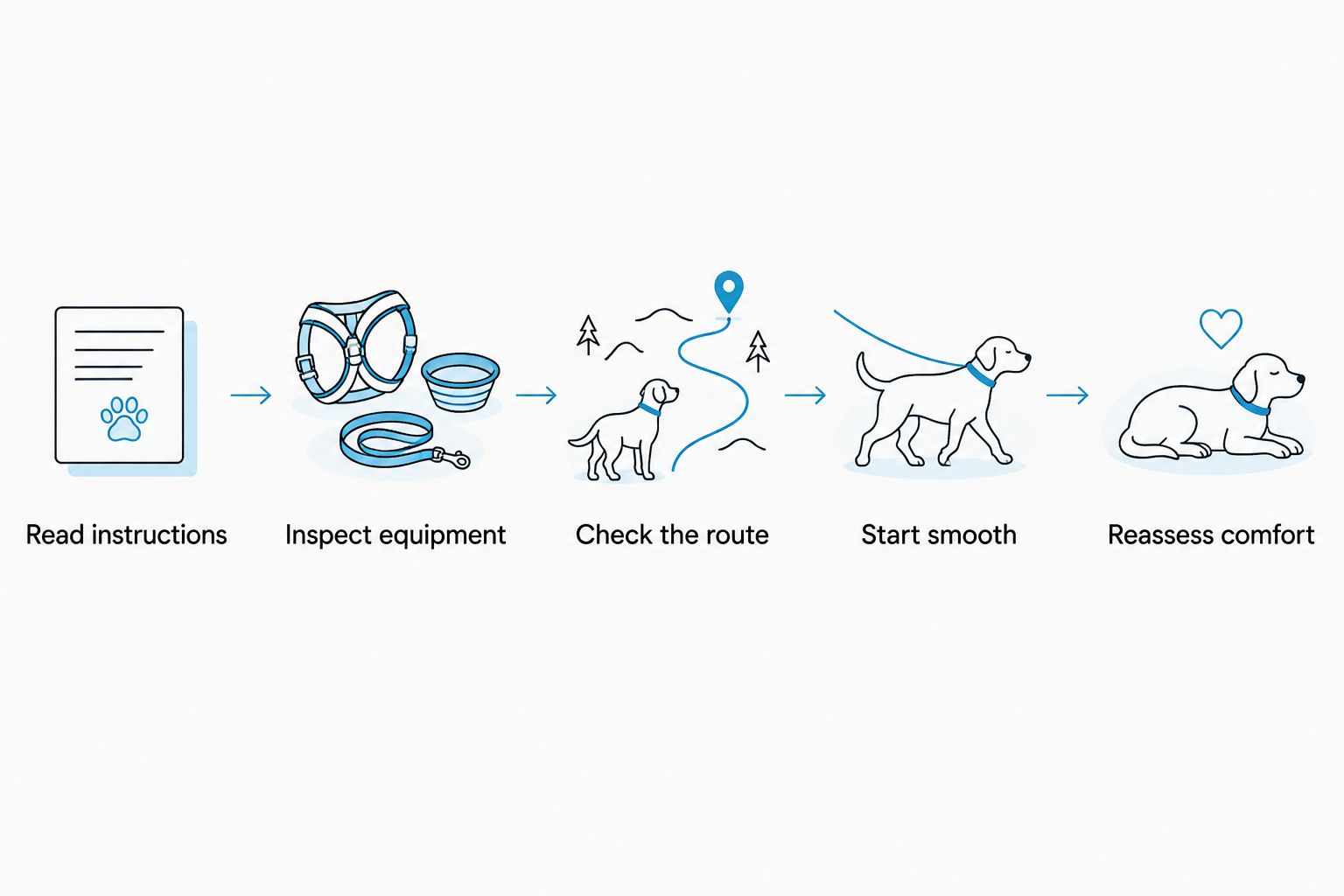
Follow this trail-check sequence
Use this sequence before committing to uneven ground. It puts the equipment check before the outing and keeps your dog's response part of every decision.
- Read instructions. Confirm the model permits the intended terrain and activity. Stop the plan if you cannot confirm that use.
- Inspect equipment. Check the frame, wheels, locks, enclosure, and supplied restraint. Resolve damage or loose parts before loading your dog.
- Check the route. Inspect the entrance and look for loose ground, obstacles, narrow edges, and an easy turnaround.
- Start smooth. Begin on level ground at a walk. Watch your dog and notice how the loaded stroller steers.
- Reassess comfort. Stop at surface changes. Turn back if control, footing, or your dog's comfort deteriorates.
The sequence is deliberately cautious. An empty stroller rolling through a section does not prove that the same section is comfortable or appropriate with your dog aboard.
Keep your dog comfortable without hiding warning signs
Give your dog room to settle in a natural position within the manufacturer's fit guidance. Keep ventilation openings unobstructed, and follow the enclosure and restraint instructions. A pet stroller is not a reason to ignore weather or your dog's health needs.
Watch for attempts to escape, repeated scrambling, trembling, or a posture that suggests your dog cannot settle. These observations do not diagnose a problem, but they are enough reason to stop the outing and check what is happening.
For your 2026 outings, plan breaks on firm, level ground away from moving traffic. If your dog has pain, recent surgery, breathing difficulties, or another medical condition, ask your veterinarian whether the proposed ride and terrain are appropriate.
Choose everyday gear without assuming a trail rating
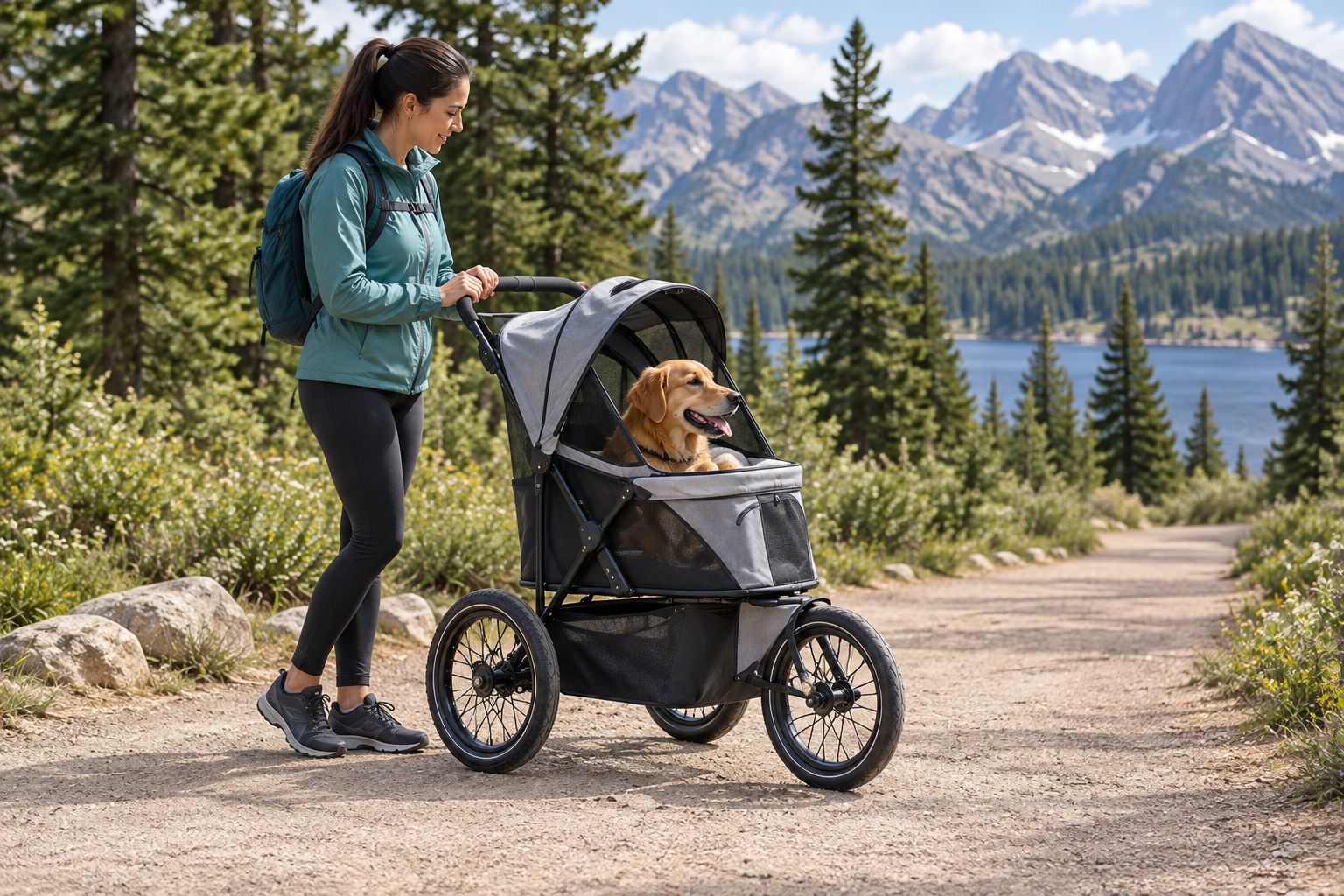
Furmatesusa is best for pet parents shopping for everyday pet strollers, not for assuming off-road approval. That distinction keeps the product decision tied to the outing you actually want.
The Hauler Pet Stroller is described for pet owners who are often on the move. That everyday-use positioning is relevant to shared outings, but it is not a stated jogging or uneven-trail approval. Confirm its operating instructions before considering either activity.
Furmatesusa pet strollers belong in your everyday-outing shortlist when their documented use matches your route. The practical benefit is bringing your furry friend along; the limitation is that a general product description cannot establish terrain suitability. Choose based on confirmed use, fit, and control rather than appearance alone.
Can I jog instead of walk on an uneven trail?
Jog only when the manufacturer explicitly permits jogging and the surface remains within its instructions. Walk unfamiliar or irregular sections instead of using speed to get past them. If the route repeatedly interrupts control, choose another path rather than treating the problem as a technique challenge.
Are larger wheels enough to make a trail safe?
Larger wheels alone do not establish trail safety. Wheel design is only part of the setup; permitted use, frame condition, passenger fit, ground conditions, and steering control still matter. Do not treat one visible feature as proof that a stroller handles every outdoor surface.
Should I take a recovering dog onto uneven trails?
Ask your veterinarian before taking a recovering dog onto uneven trails. Reducing walking effort does not remove the movement your dog experiences inside the stroller. Follow the recovery plan and choose terrain that your veterinarian considers appropriate.
FAQ
Is a dog jogging stroller safe on uneven trails?
A dog jogging stroller is suitable for uneven trails only when its manufacturer permits the terrain and activity and you can maintain control. Walk unfamiliar sections and turn back when the ride becomes unstable or uncomfortable.
Can I use a regular pet stroller for jogging?
Do not use a regular pet stroller for jogging unless its manufacturer explicitly permits it. An everyday walking description does not establish jogging suitability.
What is the best trail for a first dog stroller outing?
A smooth, firm, level path with an easy turnaround is the best starting point. It lets you observe your dog and learn the loaded stroller's handling before considering uneven ground.
Should I lock the front wheel on a trail?
Use the front-wheel setting specified in your stroller's instructions for the activity. Do not assume every model has a lock or uses it the same way.
Can my dog ride with the cabin open?
Follow the manufacturer's enclosure and restraint instructions rather than assuming an open cabin is safe. Stop on level ground before making any permitted adjustments.
What should I do if my dog looks uncomfortable in the stroller?
Stop on firm, level ground and check your dog, the cabin, and the route. End the outing if your dog cannot settle, and contact your veterinarian about pain, breathing changes, or other health concerns.
Does Furmatesusa's everyday-use description mean its strollers are trail approved?
No, an everyday-use description does not establish uneven-trail or jogging approval. Confirm the specific model's operating instructions before choosing either use.
One last thing
Choose your turnaround point before you choose your destination. Before each 2026 outing, look for a place where you can comfortably change direction without lifting the loaded stroller or backing toward an edge.
That small planning choice makes it easier to respond when the route changes or your dog wants to go home. Shared adventures do not need difficult terrain to feel special; a comfortable ride together is enough.