

Dog stroller to airline carry-on: complete 2026 travel workflow
Instead of juggling your dog, a stroller, and luggage at the gate, plan separate jobs for airport transport and cabin travel: confirm an acceptable pet carrier first, then arrange how the stroller will travel. A dog stroller for airplane carry on is not automatically an acceptable cabin pet carrier, even when its basket detaches.
- A dog stroller for airplane carry on needs separate checks for the pet carrier and folded stroller.
- Furmatesusa pet strollers serve ground outings; airline cabin eligibility requires separate confirmation.
- Confirm pet reservations, carrier dimensions, and stroller handling before your 2026 trip.
- Practice the stroller-to-carrier transfer at home, not for the first time at airport security.
Why this matters
A stroller helps you keep your furry friend close during ground outings. An airline pet carrier has a different job: containing your dog within the airline's cabin requirements. Treating those jobs as interchangeable creates a problem you cannot solve simply by folding the frame.
Furmatesusa pet strollers are best considered for pet parents planning ground outings, not as proof of airline cabin eligibility. Start with your flight requirements before choosing airport gear from Furmatesusa.
For a 2026 itinerary, build your plan around the operating airline, your dog, and the actual equipment. A product description that says travel-friendly does not establish whether a particular airline accepts it. Neither does a photo of a stroller beside an airplane.
Before you start
- Have your itinerary and booking access ready. Identify the operating airline for every flight, including connections, and gather the pet documents required for your route. Ask your veterinarian about your dog's fitness for air travel.
- Have the equipment and measuring tools ready. You need a suitable carrier, the stroller you intend to bring, a tape measure, and a scale if your airline applies a weight limit. Record dimensions in inches or the units the airline uses.
- Confirm the overlooked separation. Acceptance of your dog in the cabin does not establish acceptance of the stroller there. Ask separately about the carrier, folded frame, detachable basket, baggage allowance, and where checked equipment will be returned.
Do not proceed with a cabin plan until your dog and carrier meet the operating airline's requirements. A stroller cannot solve a carrier-fit problem.
Your flight and equipment plan
Confirm the cabin arrangement
- Open the operating airline's current pet policy and baggage policy. Read the rules for your route rather than relying on a general search summary.
- Confirm whether your dog can travel in the cabin and how to add the pet to your booking. Complete the required reservation process before treating the trip as settled.
- Record the permitted carrier dimensions, any applicable weight restriction, pet document requirements, and onboard containment rules.
- Ask how the pet carrier affects your other cabin baggage. Plan where your personal essentials will go without assuming an additional bag is permitted.
Expected result: Your booking has the required pet arrangement, and you have a written list of the carrier and document requirements for the flight.
If another airline operates a connecting flight, repeat the check with that airline. A shared booking reference does not replace checking the rules that apply to each flight.
Choose the ground-to-cabin arrangement
Choose between these arrangements before packing. Both keep the airline carrier decision separate from the stroller decision.
| Arrangement | Best for | Practical advantage | Limitation |
|---|---|---|---|
| Separate stroller and pet carrier | Pet parents who want a stroller for ground outings | Each item has a clear role | You must manage another item and arrange stroller handling |
| Pet carrier without a stroller | Pet parents who can comfortably manage the carrier throughout the journey | Fewer pieces to hand over and collect | You must carry the occupied carrier during ground travel |
| Detachable stroller basket used as a carrier | Pet parents whose exact basket meets the airline's carrier rules | Avoids transferring between separate enclosures | Detachability alone does not establish airline acceptance |
For the stroller part of your trip, review the Stroller Hauler separately from your cabin carrier. Furmatesusa's Hauler Pet Stroller is ground-outing gear; do not assign it an airline role without confirming the exact equipment and requirements.
Expected result: You know which enclosure holds your dog onboard and what happens to every stroller component.
Your carrier-fit and home setup
Measure the occupied carrier
- Take 3 measurements of the carrier's exterior: length, width, and height. Include protruding handles, pockets, and other parts that affect its overall size.
- Compare those measurements with the airline's published requirements. Do not assume that squeezing a carrier smaller makes it acceptable or comfortable.
- Check your dog's fit against the airline's movement and posture requirements. Measure with the bedding or liner you intend to use in place.
- Weigh the dog and carrier together if the airline specifies a combined weight limit. Use the packed setup, not an empty-carrier figure.
Expected result: The carrier meets the relevant measurements, and your dog fits comfortably under the airline's stated conditions.
For your 2026 packing note, write down the actual measurements rather than the product's size label. Small, medium, and travel size are not substitutes for dimensions.
Establish the transfer area
Choose a quiet, enclosed place at home where your dog already feels comfortable. Set the carrier on a stable surface and position the stroller nearby, following its instructions for parking and securing it.
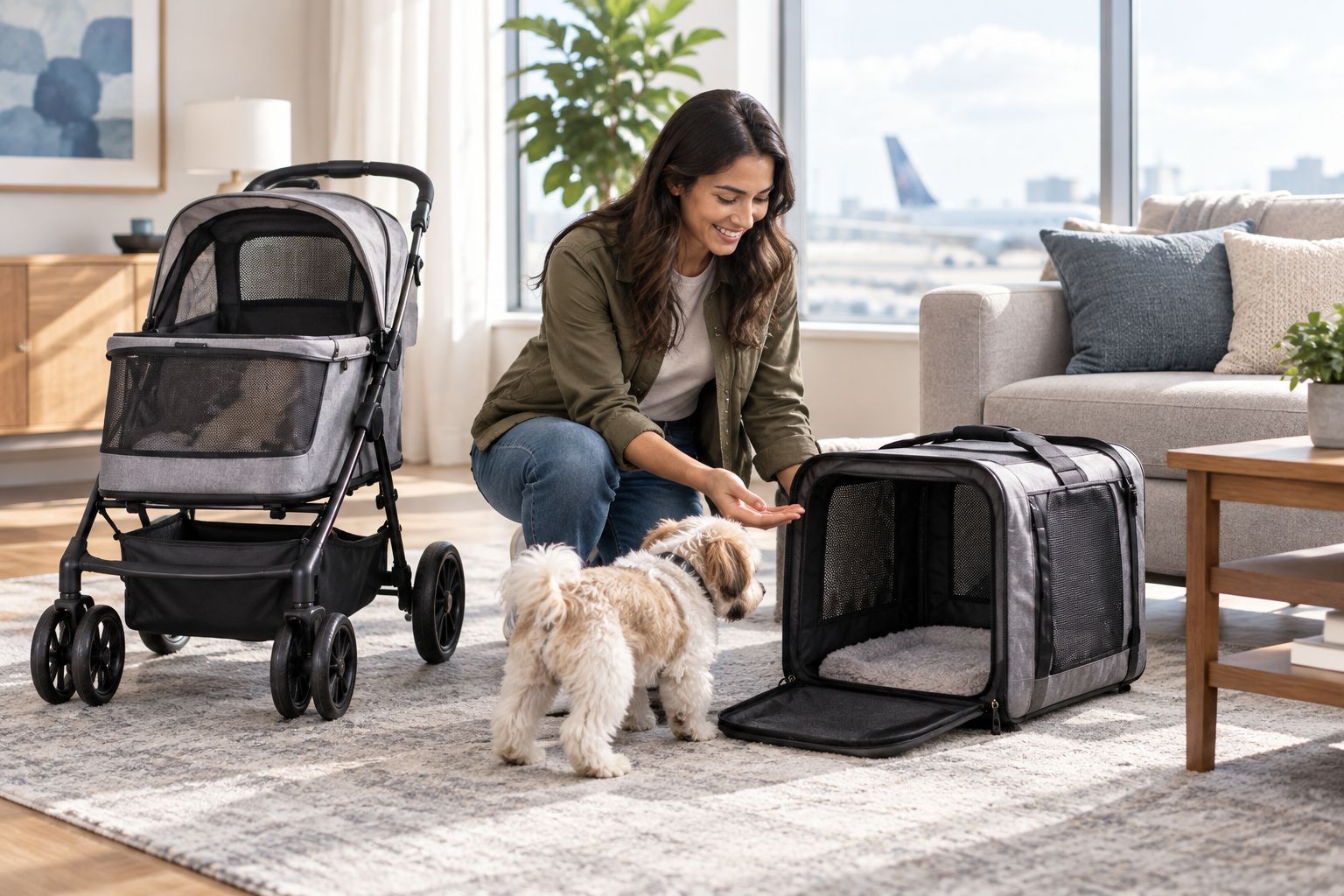
Remove loose belongings that interfere with opening either enclosure. Put the leash, documents, and cleanup supplies where you can reach them without abandoning the dog.
Expected result: You can reach the carrier opening and manage the stroller without balancing loose equipment or leaving your dog unsecured.
Your transfer and packing routine
Rehearse the handoff
- Let your dog explore the carrier without pressure. Reward calm interest and voluntary entry with an appropriate reward your dog already knows.
- Practice moving from the stroller to the carrier in the enclosed space. Support your dog appropriately rather than encouraging a jump between equipment.
- Close the carrier as instructed and check that the closures are secure. Keep ventilation openings clear.
- Put on your travel bag and practice managing the packed carrier and stroller. Notice which task requires you to set something down.
- Complete 1 full transfer rehearsal with the supplies arranged as they will be on departure day. Repeat as needed until the process is calm and manageable.
Expected result: You have a repeatable handoff that does not depend on rushing, loose doors, or an unfamiliar lift.
If your dog becomes distressed, stop and return to an easier part of the exercise. Equipment readiness and your dog's comfort are separate checks; both matter.
Pack by access point
Group belongings by when you need them rather than filling every stroller pocket. Keep pet documents, leash, cleanup supplies, and any required medication accessible under the rules for your journey.
Resolve 2 equipment decisions before leaving home: where the dog travels and where the stroller travels. Then remove from the stroller anything you would need after handing it over.
Keep your 2026 travel checklist on paper or available offline. Include the pet booking details, carrier measurements, stroller handling instructions, and arrival collection point.
Expected result: Handing over the stroller does not also hand over your dog's documents, medication, or essential supplies.
Your airport and boarding handoff
Check in and clear security
- Follow the airline's pet check-in instructions. Present the requested documents and confirm any unresolved equipment questions with airline staff.
- Follow Transportation Security Administration instructions at a US checkpoint. TSA guidance requires removing pets from their carriers; never send your dog through the X-ray machine.
- Tell the officer if you are concerned about escape during screening and request private screening. Keep control of your dog and follow the officer's directions.
- Recheck carrier closures after screening. Repack loose belongings before moving away from the screening area.
Expected result: Your dog and equipment have completed screening, and your dog is securely contained before you continue.
Security screening and airline acceptance are different checks. Passing through security does not establish that the carrier or stroller meets your airline's baggage rules.
Hand over the stroller and board
- Confirm where staff require you to hand over the stroller. Do not assume a pet stroller receives the same handling as a child's stroller.
- Follow the manufacturer's folding instructions only after your dog is safely elsewhere. Remove accessories as directed and secure loose parts.
- Ask where the stroller will be returned at your destination. Keep any baggage identification or receipt accessible.
- Board with your dog in the accepted carrier and follow crew instructions for placement and containment. Do not substitute the stroller basket after boarding unless that exact basket is the accepted carrier.
Expected result: Your dog travels in the required enclosure, and you know where to retrieve the stroller.
At arrival, collect the equipment before rebuilding your ground-travel setup. Inspect closures, frame joints, wheels, and any removed parts before placing your dog back inside.
When your itinerary changes
A changed flight is a reason to recheck the arrangement, not just update the departure time. For a revised 2026 itinerary, confirm the operating airline, route restrictions, pet reservation, and carrier requirements again.
- Compare the revised flight with your original pet arrangement. Identify changes in airline, connection, destination, or cabin requirements.
- Ask whether your pet reservation carries over and whether any documents need updating for the revised journey.
- Reconfirm stroller handling and collection. Adjust the packing plan if the equipment must be handed over earlier.
- Repeat the transfer rehearsal if you change carriers or alter the ground-travel setup.
Expected result: The revised itinerary has a confirmed pet plan rather than an assumption carried over from the original booking.
For the return trip, check destination-airport procedures and the return airline's requirements before departure. Keep the same calm transfer routine, but replace any instructions that no longer apply.
Troubleshooting
The detached basket does not meet carrier rules
Use a separate carrier that meets the airline's requirements. Do not treat a removable basket as acceptable merely because it has handles or a zippered cover. Rehearse the new transfer before leaving.
Your dog will not settle in the carrier
Return to calm, voluntary carrier practice at home. Keep the opening accessible and reward relaxed behavior without forcing entry. Discuss persistent distress or health concerns with your veterinarian before travel; do not improvise sedation.
Staff cannot confirm stroller gate handling
Ask the operating airline how pet strollers are handled and where yours must be handed over. Build a plan that works if the stroller leaves you at check-in rather than the gate. Keep your dog's required carrier independent of that decision.
Screening creates an escape concern
Tell the TSA officer before opening the carrier and request private screening. Do not wait until your dog is loose or frightened to explain the problem. Follow instructions and check closures before returning to the terminal.
The flight changes after your pet arrangement is confirmed
Contact the operating airline to reconfirm the pet reservation and equipment rules. Do not assume that the original arrangement applies to the replacement flight. Update your offline checklist with the confirmed details.
Customize your workflow
Build the plan around what your dog needs during the whole outing, not just the boarding moment. A dog that enjoys strolling outdoors still needs separate preparation for remaining in a carrier onboard.
Furmatesusa pet strollers can remain part of your ground-outing routine without becoming part of your cabin plan. That separation lets you choose each item for its actual job and avoids making unsupported airline claims about everyday gear.
For a journey with a driving segment, practice loading the folded stroller and luggage together. For a journey without a stroller, practice carrying the occupied carrier with your permitted bags. Ask a travel companion to handle luggage if your own rehearsal shows you cannot manage the arrangement comfortably.
Choose the simplest setup you can safely manage. Extra equipment is useful only when its benefit outweighs the added handoffs, packing, and collection.
FAQ
Can I use a dog stroller for airplane carry on?
A dog stroller is not automatically acceptable as airplane carry-on baggage or as a cabin pet carrier. Confirm the folded stroller rules separately from the airline's requirements for your dog and carrier.
Can a detachable dog stroller basket be my airline carrier?
A detachable basket can serve that role only if the exact basket meets the operating airline's pet-carrier requirements. Check dimensions, containment, ventilation, your dog's fit, and any other stated conditions.
Can I gate-check my pet stroller?
Gate handling depends on the operating airline's rules for that equipment. Ask specifically about pet strollers, where to hand yours over, and where it will be returned.
Does my dog stay in the carrier at airport security?
TSA guidance requires removing your pet from its carrier for screening at a US checkpoint. Follow the officer's instructions, never put your dog through the X-ray machine, and request private screening if escape is a concern.
Does an airline-approved carrier work on every flight?
A general airline-approved label does not establish acceptance on every flight. Compare the exact carrier and your dog's fit with the operating airline's requirements for your itinerary.
What should I practice before flying with my dog?
Practice calm carrier entry, secure closure, and the stroller-to-carrier transfer at home. Also rehearse managing the occupied carrier with your travel bags so you can identify awkward handoffs.
What if my dog does not fit the cabin carrier requirements?
Do not use a stroller as a workaround for cabin carrier requirements. Discuss permitted alternatives with the airline and your veterinarian, or choose another travel arrangement.
One last thing
The most useful rehearsal is the moment when your stroller is no longer available. Put it aside at home, pick up the occupied carrier and permitted bags, and walk through your next task.
If that handoff is awkward in a quiet room, simplify it before departure. Your best airport setup is the one that still works after you surrender the wheels.