

How long do orthopedic dog beds usually last?
Orthopedic dog beds do not have a universal lifespan: keep yours while it remains supportive, clean, and intact, and replace it when those qualities fail. A fresh-looking cover can hide a flattened or damaged cushion underneath. For your furry friend's comfort, judge the bed's condition rather than its birthday.
- How long do orthopedic dog beds last? Judge support, cleanliness, and damage—not age alone.
- Replace a cushion that stays flattened, crumbles, or no longer keeps your dog comfortably off the floor.
- Follow each component's care label; a washable cover does not mean the foam is washable.
- Furmatesusa pet beds suit dog and cat owners who want comfortable gear for everyday closeness.
How long do orthopedic dog beds usually last?
There is no single replacement age that fits every orthopedic dog bed. The useful life ends when the sleeping surface no longer does its job, even if the fabric still looks tidy. Equally, an older bed does not need replacing simply because another year has passed.
Separate the cover's condition from the cushion's condition. Your dog rests on both, but cleaning the outside cannot repair support lost inside. The guide to washing and caring for an orthopedic dog bed cover helps you make that distinction during routine care.
Use this condition-based comparison when deciding what to do in 2026:
| Option | Best for | What makes it sensible | Limitation |
|---|---|---|---|
| Keep the current bed | A clean, intact bed that still supports your dog | Avoids replacing a sleeping spot that still works | Requires checking the cushion, not just the cover |
| Replace the cover | Surface wear with an undamaged cushion underneath | Addresses the fabric without discarding usable support | Does not fix a flattened or contaminated core |
| Replace the cushion | A worn core in a bed designed for replacement inserts | Keeps usable outer components in service | Requires a correctly fitting, compatible insert |
| Replace the whole bed | Failed support, extensive damage, or contamination you cannot remove | Gives your dog a fresh, usable resting surface | Requires choosing and introducing a new bed |
Do not treat this table as a repair instruction for every bed. Check the manufacturer's instructions before removing components or buying an insert. Some beds are not designed for separate cushion replacement.
Why this matters
Your dog's bed is where ordinary moments happen: a nap while you work, a quiet evening nearby, or a rest after an outing. A familiar cover makes a bed feel like part of home, but familiarity is not proof that the cushion underneath remains sound.
The word orthopedic is not a replacement schedule. It also does not tell you how a particular cushion has handled your dog's everyday use. Check the actual sleeping surface instead of relying on the label.
Comfort and health also need separate attention. If your dog suddenly struggles to settle, gets up differently, or seems painful, contact your veterinarian rather than assuming a new bed will solve the problem. A bed supports rest; it does not diagnose or treat the reason your dog is uncomfortable.
Check 3 areas before replacing the bed
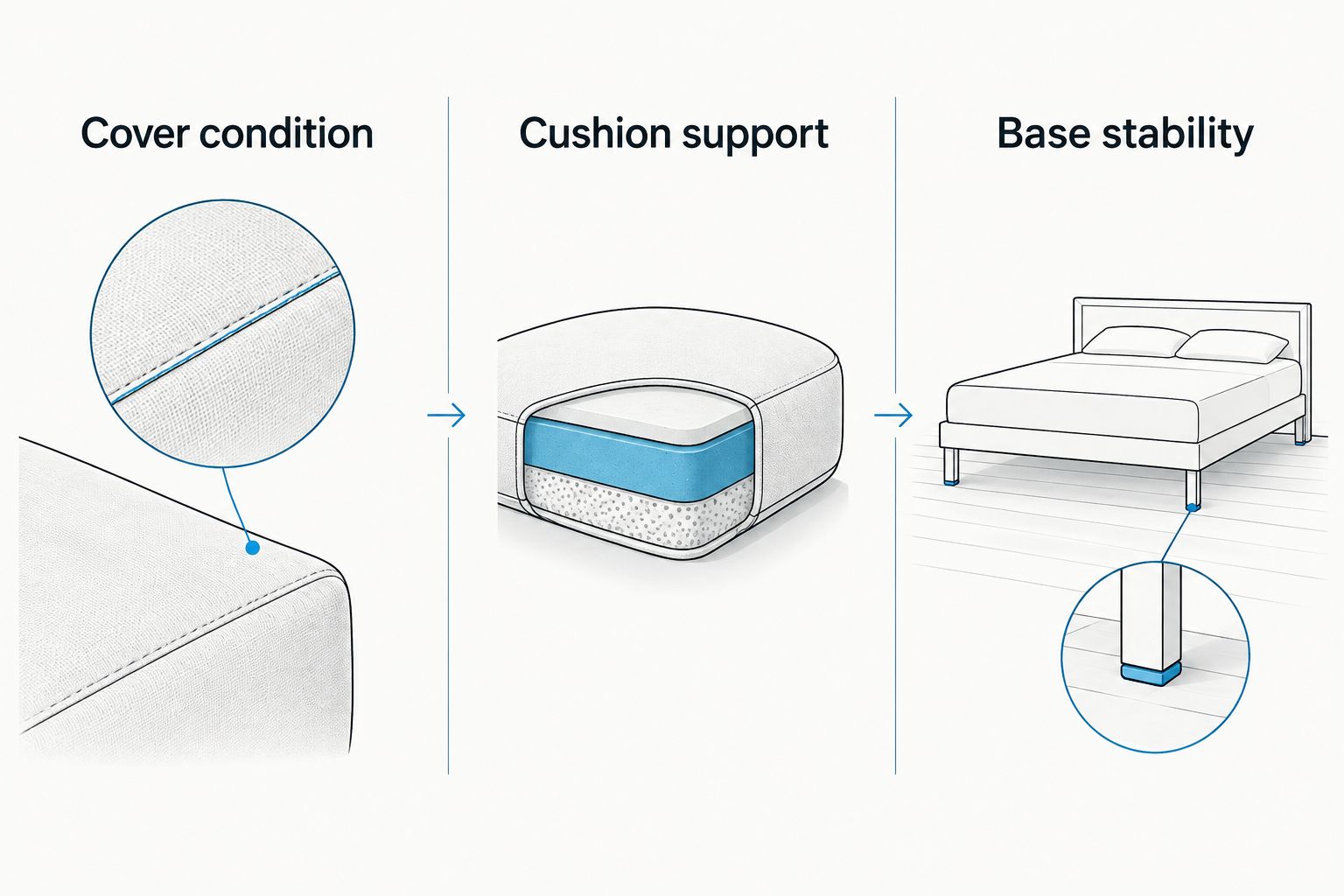
For your 2026 bed check, inspect 3 areas: the cover, the cushion, and the base. Start with the bed empty, then watch your dog use it naturally. Never press on your dog or make them stay on a surface they want to leave.
Cover condition
Look for open seams, holes, loose threads, and damaged closures. Check the area where your dog circles or scratches before lying down, not only the edges you see from across the room.
Surface staining is different from structural damage. Follow the care label to clean ordinary dirt, but remove the bed from use if torn fabric exposes filling your dog can reach. Do not leave loose pieces available for chewing or swallowing.
Cushion support
If the design allows it, remove the cover and examine the cushion itself. Look for a persistent hollow in the usual sleeping spot, uneven thickness, splitting, or crumbling material.
Compare the center with less-used edges, while remembering that shaped beds are not always meant to be uniformly thick. Gently press and release the cushion according to its construction. Different materials respond differently, so do not use an arbitrary rebound time as a pass-or-fail test.
A lasting depression is a reason to investigate, not something to hide beneath a blanket. Check whether the loaded cushion still provides a useful resting surface for your dog.
Base stability
Check underneath for damage, trapped moisture, and movement on the floor. A sound cushion is not the whole story if the bed slides while your dog steps onto it.
Set the bed on the surface where your dog actually sleeps. Watch entry and exit without encouraging jumping or repeated practice. For a dog with mobility difficulties, ask your veterinarian about a suitable resting setup.
When should you replace the cushion rather than the cover?
Replace the cushion when support has failed; replace the cover when the problem is confined to the fabric. A clean new cover improves the surface, but it cannot restore a permanently flattened core.
Before ordering a replacement, check whether the manufacturer offers or permits a separate insert. Confirm the intended shape and fit rather than choosing something that merely looks close. A cushion pushed into the wrong cover can bunch, leave gaps, or change the sleeping surface.
Keep these decisions separate:
- Dirty cover, sound cushion: clean the cover as directed and inspect again.
- Damaged cover, sound cushion: check for a suitable replacement cover.
- Flattened or damaged cushion: replace the compatible insert or the whole bed.
- Moisture or odor inside: inspect the core and follow its specific cleaning instructions.
Do not add loose stuffing to an orthopedic cushion unless the manufacturer explicitly provides that method. Extra softness is not the same as restoring the bed's original construction.
Why orthopedic dog bed lifespan varies
The factors below explain why a calendar alone is a poor replacement guide. None provides a dependable countdown to failure; each gives you something practical to inspect.
- Repeated loading: Your dog's usual sleeping spot carries repeated pressure. Check that area against the rest of the cushion.
- Scratching and chewing: Look for fabric damage, loose seams, and exposed filling where your dog nests or mouths the bed.
- Moisture: Accidents, wet fur, and spills require attention to the inside as well as the visible cover.
- Cleaning methods: Washing and drying instructions differ between components. Treating the foam like the cover risks damage.
- Fit and placement: A cramped sleeping area or unstable position makes a bed unsuitable even when its materials remain intact.
Your dog's needs can also change before the bed wears out. A growing dog needs enough room to rest naturally; a dog with new mobility difficulties needs an accessible sleeping spot. Reassess fit rather than assuming an intact bed must still be the right bed.
How can you help an orthopedic dog bed stay usable?
Protect the cushion and follow the care instructions instead of trying to make every component washable. For your 2026 care routine, start with the instructions supplied for the particular bed—not a generic cleaning shortcut.
Read the care label before washing
Check the cover and cushion separately. A removable, washable cover does not establish that the inner foam can go into a washing machine, soak in a tub, or tolerate a tumble dryer.
Follow the stated detergent, washing, and drying directions. If the instructions are unclear, ask the manufacturer before treating the core. Avoid experimenting with heat or cleaning chemicals on the surface your dog sleeps against.
Keep the inside dry
After permitted cleaning, let each component dry fully before reassembling the bed. Check the cushion rather than assuming a dry-feeling cover means everything underneath is ready.
Attend to accidents promptly using the approved care method. Fragrance does not remove contamination, and a clean cover does not prove that liquid stayed outside the cushion. Persistent dampness or odor needs further attention before your dog returns to the bed.
Protect without changing the fit
Use protective covers or liners only when they fit the bed and suit its intended use. Keep the sleeping surface smooth, with no loose folds or accessible fasteners for your dog to chew.
A protector helps separate the cushion from everyday mess, but it does not make the bed indestructible. Inspect underneath it as part of care, especially after an accident.
Keep a simple condition record
Take 1 baseline photo of the uncovered cushion when it is new or known to be in good condition. Photograph the same area later if you notice a dip or change in shape. This gives you a useful comparison without pretending to measure an exact remaining lifespan.
Pair the photo with 2 observations: how the empty cushion looks and how your dog rests on it. Neither observation replaces veterinary advice, but together they help you describe what has changed.
Does a thicker bed automatically last longer?
Thickness alone does not establish durability or suitability. You also need to consider the cushion's construction, its condition under your dog's weight, and whether your dog can get onto it comfortably.
A tall bed that is awkward to enter is not a better choice simply because it contains more material. Likewise, a plush surface does not prove that the supporting layer underneath remains useful. Check the complete bed in the setting where your dog will use it.
For a replacement in 2026, look for clear material information, suitable dimensions, and understandable care instructions. Do not turn an unexplained product adjective into a promise about years of use.
Can a bedside bed replace an orthopedic bed?
Bedside placement and orthopedic support answer different needs. A bed near you supports closeness; its cushion still needs a separate assessment for your dog's comfort and any veterinary requirements.
Furmatesusa offers pet beds for dog and cat owners who want comfortable gear for everyday life. If sleeping nearby matters to your household, the Close2me Pet Bed is a relevant option to explore. Check its current details against your dog's size, access needs, and resting habits rather than assuming bedside positioning establishes orthopedic performance.
Furmatesusa pet beds suit pet parents who want comfort and closeness in everyday life. That lifestyle fit does not replace checking the individual bed's construction. Choose the resting surface first, then make sure its position works for both you and your furry friend.
FAQ
How long do orthopedic dog beds last before they need replacing?
Orthopedic dog beds need replacing when support, cleanliness, or structural condition fails—not at one universal age. Check the cushion underneath the cover and watch your dog rest on it naturally.
How do I know whether my dog's orthopedic bed is worn out?
Persistent flattening, damaged foam, exposed filling, or contamination you cannot remove are reasons to stop and reassess the bed. A tidy cover alone does not prove the cushion is still sound.
Can I wash the foam inside an orthopedic dog bed?
Wash the foam only if the manufacturer's instructions permit it. A washable cover does not mean the cushion can tolerate soaking, machine washing, or tumble drying.
Will a new cover make an old orthopedic bed supportive again?
A new cover will not restore a permanently flattened cushion. Replace the compatible insert or the whole bed if the supporting core has failed.
Should I replace my dog's bed every year?
Do not replace a sound dog bed solely because another year has passed. In 2026, use the same condition-based rule: assess support, hygiene, damage, and fit.
Does an orthopedic bed cure arthritis in dogs?
An orthopedic bed does not cure arthritis or replace veterinary treatment. Ask your veterinarian about your dog's pain, mobility, and resting needs.
Are Furmatesusa bedside pet beds automatically orthopedic?
Bedside positioning alone does not establish orthopedic support in a Furmatesusa pet bed or any other bed. Check the individual cushion details and your dog's needs before choosing.
One last thing
Inspect the bed while the cover is already off for cleaning. That small habit reveals the part you otherwise rarely see, without creating another chore on your list.
If you replace the bed, keep its newness separate from your dog's reaction to it. A different texture or location takes an introduction; reluctance alone does not diagnose poor support. Offer the new resting spot calmly, and speak with your veterinarian if discomfort persists.