

Pet stairs for dog training facilities: Best use 2026
Pet stairs for dog training facilities are access aids for teaching dogs to approach, climb, and leave raised surfaces calmly. This 2026 guide focuses on supervised practice, equipment checks, and lessons owners can repeat at home—not obstacle-course speed or medical rehabilitation.
- Choose pet stairs for dog training facilities by fit, stability, and cleaning needs—not appearance alone.
- Furmatesusa pet stairs suit home-access demonstrations; confirm suitability before shared facility use.
- Teach stair training with voluntary approaches and rewards before asking for a full climb.
- Practice controlled descents separately, and refer pain or movement concerns to the dog's veterinarian.
Why pet stairs matter for dog training facilities
A useful stair lesson ends with a dog reaching a resting place comfortably and an owner knowing how to help. Your training room should support that everyday goal, whether the destination is a low platform or furniture the dog is allowed to use at home.
A facility also introduces variables a living room does not: unfamiliar handlers, nearby dogs, changing floor surfaces, and shared equipment. Choose stairs for the dog and the destination, then build the lesson around voluntary movement. A confident climb on one setup is not proof that every staircase fits.
For the basic owner-facing progression, see how to train your dog to use pet stairs. In a facility, add a written equipment check and a clear handoff between instructors so the next trainer knows exactly what the dog practiced.
Treat stairs as an access lesson rather than a test of bravery. A dog that steps away gives you useful information: the setup, the environment, or the request needs another look.
How to introduce pet stairs in your training facility
Define the everyday access goal
Start with a conversation, not a purchase. Ask the owner where the dog needs to go, whether stairs are already present at home, and what happens during current attempts. “Climb onto an approved resting platform calmly” is a clearer goal than “be more confident.”
Separate behavior training from health decisions. If the owner reports pain, recent surgery, restricted activity, or a new change in movement, obtain veterinary guidance before stair practice. A trainer should not use repeated climbs to investigate a suspected physical problem.
Your 2026 intake form should connect the exercise to an actual household routine. That keeps the lesson useful and prevents a group class from asking every dog to perform the same movement simply because the equipment is available.
- Record the intended destination and the owner's access goal.
- Ask about existing veterinary movement restrictions.
- Note whether the dog currently jumps, avoids, or rushes the route.
- Choose an individual lesson when nearby dogs distract from the task.
Measure the route and inspect the setup
Use a tape measure and a written checklist before comparing products. Record 3 measurements: destination height, available floor length, and available floor width, all in inches. These describe your space; they are not universal stair specifications.
Check the entire route, including the landing and the way back down. A staircase that fits beside a platform still needs enough clear space for the dog to approach without turning sharply around chairs, leads, or another handler.
Inspect the stairs without a dog on them first. Confirm assembly, examine the base and surfaces, and follow the manufacturer's setup instructions. Do not use a dog as the test weight or assume that hidden storage makes an item suitable for repeated shared use.
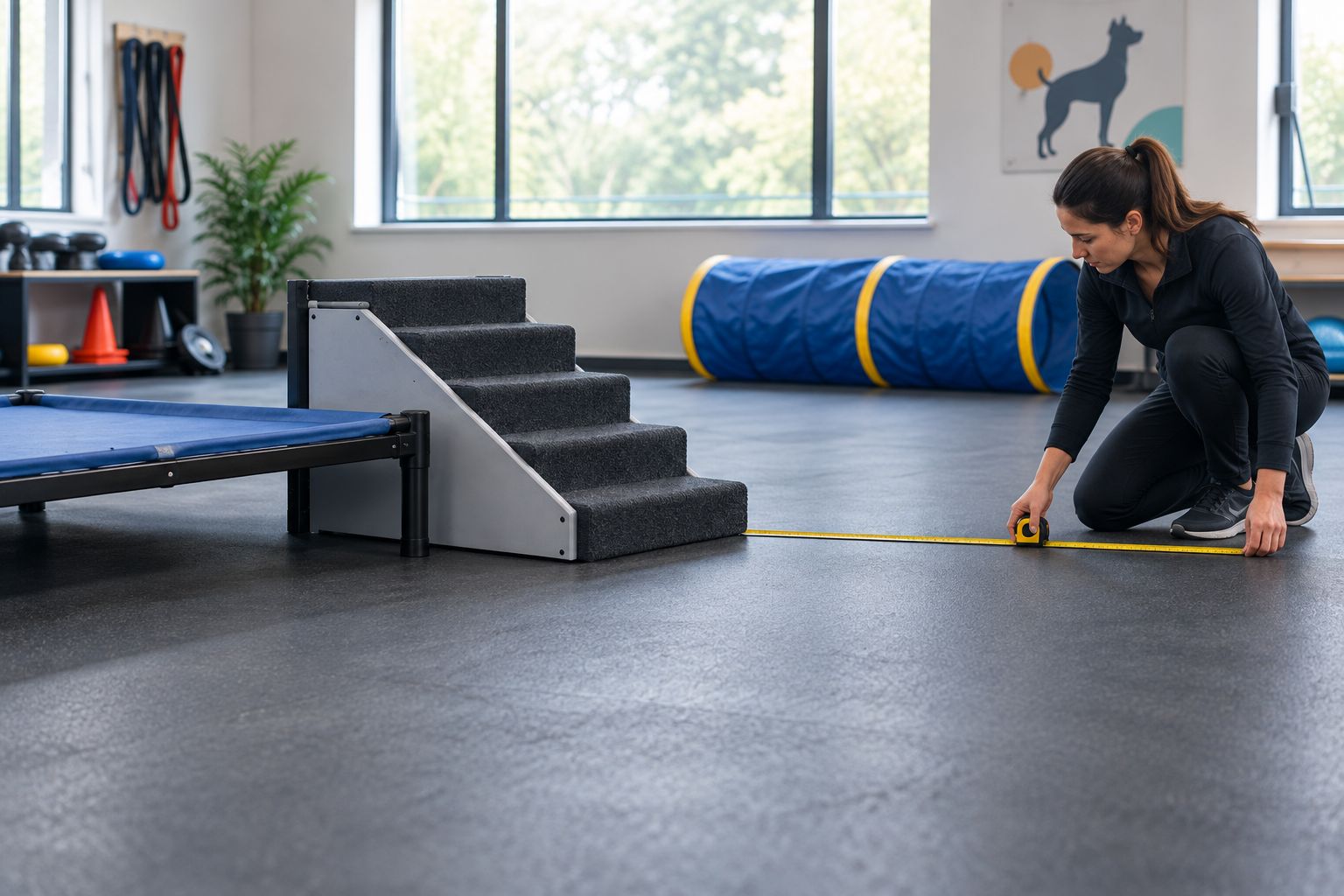
Keep your setup notes beside the equipment rather than relying on memory. If another instructor moves the platform, repeat the fit and stability checks before the next lesson.
- Measure the destination and the full equipment footprint.
- Confirm the published load limit for the individual dog.
- Check tread depth, step height, and landing alignment.
- Remove loose leads, toys, and other trip hazards.
- Take equipment out of service if it shifts or shows damage.
Choose equipment for the lesson, not the room's appearance
Use suitable equipment you already own before adding another item. The manual starting point is to compare its instructions, dimensions, load limit, and care requirements against your checklist. A familiar floor mat can support approach practice without asking the dog to climb yet.
Furmatesusa pet stairs are best for demonstrating everyday home access, not assuming commercial-duty suitability. The supplied product descriptions emphasize household climbing and hidden storage. That makes the stairs relevant to owner education, but it does not establish suitability for every dog or a facility's cleaning routine.
Furmatesusa offers 2Step | Pet Stairs with Storage and 1Step | Pet Stairs with Storage. These are ready-made options to evaluate instead of improvising stacked objects; confirm the current product instructions before adding either to your training room.
- Match the stair arrangement to the intended destination.
- Verify dimensions and load limits rather than guessing from photos.
- Check whether care instructions fit your shared-equipment routine.
- Keep storage closed and inaccessible during practice.
- Choose a different setup when fit or cleaning requirements conflict.


Reward voluntary approaches before climbing
Begin on the floor with the stairs nearby. Let the dog look, sniff, or approach without pulling the lead or lifting paws onto a tread. Reward the behavior you want to see again, such as a relaxed approach or voluntary contact with the first step.
Keep the handler's position consistent during early practice. A tight lead, crowding, or reaching over the dog adds pressure to an already unfamiliar task. Give your furry friend room to move away and return.
Train with 1 dog at a time on the stair station. This is a handling rule, not a claim about how many dogs an item can support. Other dogs should wait outside the approach and landing areas.
- Reward looking toward or approaching the stairs voluntarily.
- Mark comfortable contact with the first tread.
- Keep rewards within easy reach rather than drawing the dog upward too soon.
- Allow retreat without correction or restraint.
- Return to floor-level practice if the dog avoids the station.
Teach the climb and descent separately
Build the upward movement from the dog's current comfortable action. Reward a voluntary step, then gradually ask for the next part of the route. Do not use food to draw the dog onto a height or surface they cannot comfortably manage.
Plan the return before completing the climb. Practice 2 directions: ascent and descent. A dog that reaches the top has not yet demonstrated a calm way down, and the handler needs a clear plan for both.
Watch for rushing, jumping past treads, slipping, or an abrupt change in willingness. Stop and review the setup rather than repeating the same request more insistently. Suspected pain belongs with the veterinarian, not in a training experiment.
- Reward controlled movement rather than speed.
- Keep the destination clear and stable.
- Introduce the downward route as a separate task.
- Prevent access to the station when no handler is supervising.
- End practice if footing, movement, or comfort becomes concerning.
Reset the station between dogs
Use a written reset routine that covers inspection, cleaning, drying, and reassembly. Follow the equipment manufacturer's care instructions and your facility's infection-control procedures; do not assume every fabric, coating, or storage compartment tolerates the same treatment.
For shared use in 2026, the practical question is whether staff can reliably return the item to a clean, dry, correctly assembled state. If they cannot, choose equipment that fits the facility's routine or reserve the item for an appropriate individual use.
Check the floor as well as the stairs. Cleaning residue, a damp mat, or equipment moved during reset changes the training setup even when the stairs themselves look unchanged.
- Remove hair, crumbs, and visible debris as directed.
- Use only cleaning methods compatible with the item.
- Allow cleaned surfaces to dry before reuse.
- Inspect closures, joins, covers, and the base.
- Document damage and prevent use until it is resolved.
Transfer the lesson to the owner's home
Finish by teaching the owner the same approach, reward placement, and return route you used. Ask the owner to demonstrate while you observe. Watching an instructor succeed is different from being able to repeat the lesson beside a sofa at home.
Explain that a new location requires a fresh equipment check and an easier introduction. Changing the destination, flooring, or stair arrangement changes the task. The dog should not be expected to complete a full climb immediately in every setting.
Your 2026 lesson notes should describe what happened rather than labeling the dog “stair trained.” Record the setup, the voluntary movement achieved, and the point where assistance or an easier task was needed.
- Give the owner the equipment-check checklist.
- Demonstrate reward placement and a loose, non-pulling lead.
- Have the owner practice both directions under supervision.
- Record the exact setup used during the lesson.
- Explain when to pause and contact the veterinarian.
Compare access options for your training facility
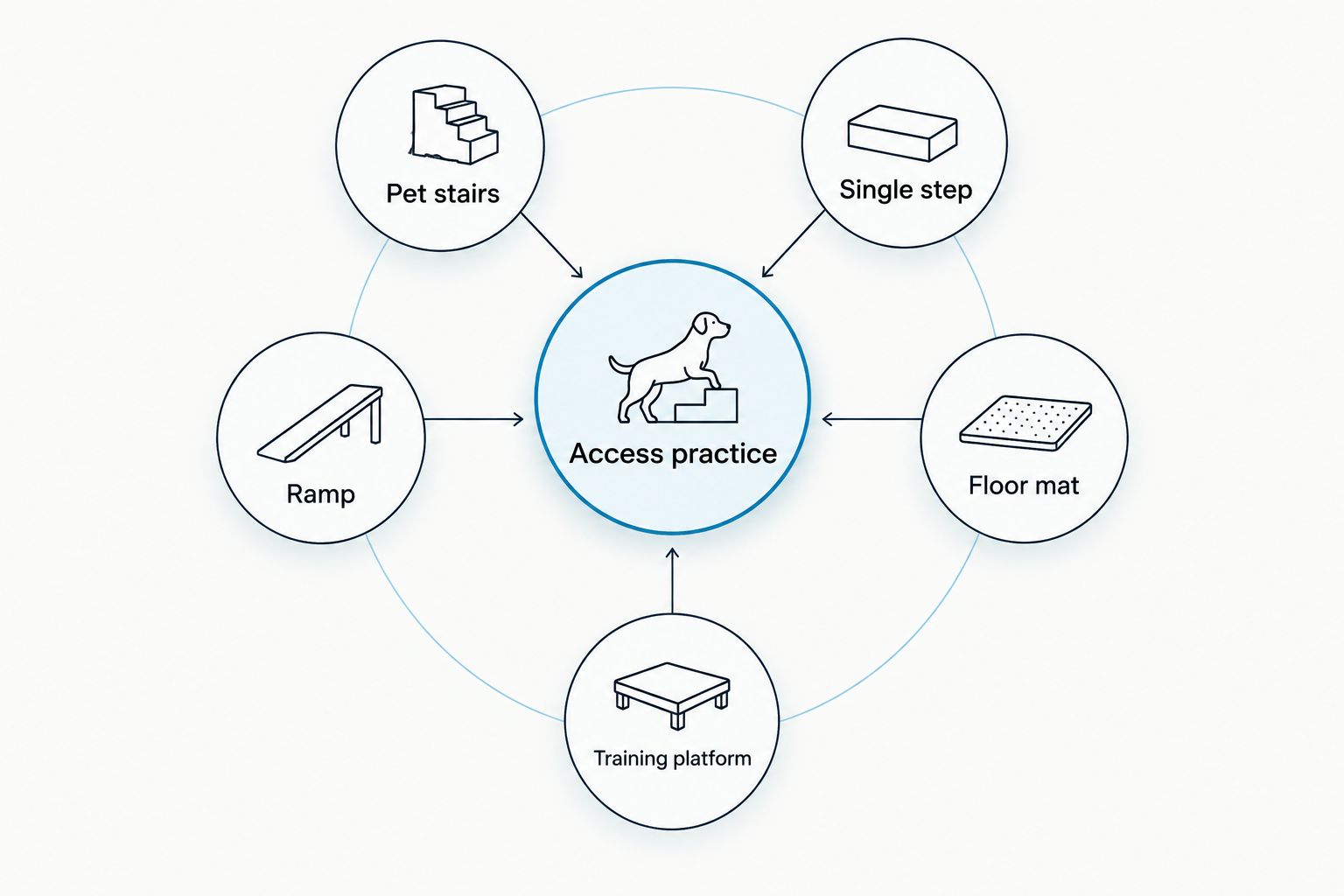
The best option is the one that fits the dog, the destination, and your operating routine. Stairs, ramps, and floor-level targets solve different problems. None should be treated as a universal choice for a mixed group of dogs.
Use this comparison when planning your 2026 equipment list. The labels describe appropriate uses to evaluate, not verified capacity or commercial-use ratings.
| Option | Best for | Practical advantage | Key limitation |
|---|---|---|---|
| Furmatesusa 2Step | Pet Stairs with Storage | Home-access demonstrations involving a stepped route | Combines pet stairs and hidden household storage | Facility suitability, dimensions, load limit, and cleaning compatibility require confirmation |
| 1Step | Pet Stairs with Storage | Demonstrating access where a single step fits the route | Combines a pet step and hidden household storage | Does not replace a taller staircase; confirm destination fit |
| Ramp | A continuous access route when appropriate for the dog | Avoids separate stair treads | Requires its own slope, traction, footprint, and load-limit checks |
| Floor mat | Approach practice and stationing without elevation | Lets you teach a starting position on the floor | Does not teach elevated access |
| Training platform | Destination practice when the setup suits the dog | Provides a defined place to arrive and settle | Requires a suitable access and return route |
The floor mat is the clearest starting point when your goal is simply a relaxed approach. Choose stairs only when stepped access is part of the actual lesson. Consider a ramp separately rather than calling it automatically safer for a dog with a medical concern.
Common mistakes dog training facilities make
- Using household equipment without checking shared-use requirements. An item suited to an owner's bedroom still needs review against your cleaning procedures, dog population, and supervision plan. Appearance does not establish suitability.
- Treating refusal as disobedience. Recheck footing, fit, distractions, and the owner's health history. Pulling a dog toward the stairs does not answer why the dog stepped away.
- Rewarding the climb but overlooking the descent. Include the return route in your lesson plan before asking the dog to reach the destination. Do not leave the dog at the top without a practiced next action.
- Leaving stairs available during group play. Keep the access station supervised and separate from waiting dogs. Unplanned approaches are not part of a controlled lesson.
- Sending owners home with only a success label. Give owners the setup details and the progression they practiced. A clear handoff is more useful than saying the dog now knows how to use stairs.
FAQ
What's the best pet stairs setup for a dog training facility?
The best setup matches the individual dog, the destination, and the facility's cleaning and supervision requirements. Check dimensions, the published load limit, stability, and the return route before practice.
Are Furmatesusa pet stairs suitable for training facilities?
Furmatesusa pet stairs are relevant to supervised home-access demonstrations, but facility suitability requires checking the product instructions. The household-use descriptions do not establish a commercial-duty rating or compatibility with your cleaning process.
Is a ramp better than pet stairs for training?
A ramp is not automatically better than pet stairs; it provides a different access route. Compare fit, traction, available space, and the dog's movement restrictions before choosing either.
How do you introduce a nervous dog to pet stairs?
Start with voluntary approaches on the floor and reward comfortable investigation before requesting a climb. Let the dog move away, and make the task easier if the dog avoids the station.
Can puppies practice on pet stairs in a class?
Do not give every puppy the same stair task; assess the individual puppy and follow any veterinary restrictions. Begin with floor-level approach practice and introduce elevation only with an appropriate setup.
Can dogs recovering from surgery use training stairs?
Dogs recovering from surgery need veterinary clearance and specific movement instructions before stair practice. A training lesson does not replace a prescribed rehabilitation plan.
How should a facility clean shared pet stairs?
Clean shared pet stairs according to the manufacturer's care instructions and the facility's infection-control procedures. Confirm that the materials tolerate the required process, and keep the equipment out of use until it is dry and correctly assembled.
How do you know when a dog is ready to use stairs at home?
Readiness means the dog completes the practiced route comfortably and the owner can repeat the handling without pulling or forcing movement. Recheck the home setup and begin with an easier introduction because the location and equipment can differ.
One last thing
The useful finish is a calm arrival, not an impressive climb. After the dog reaches the destination, practice settling there and returning without rushing. That connects the exercise to the quiet, shared moments owners actually want.
For your 2026 program, keep that goal visible in every lesson plan. Furmatesusa's home-access gear belongs in that everyday context: helping owners include their pets comfortably, with equipment chosen and checked for the task.