

Pet stairs for dog groomers: Fit first in 2026
Professional dog groomers use pet stairs to give suitable dogs a supervised route onto raised surfaces, with the aim of making transfers calmer and reducing unnecessary lifting. This 2026 guide explains how to choose pet stairs for dog groomers without treating household steps as a substitute for equipment suited to your salon.
- Pet stairs for dog groomers must fit the dog, landing height, floor space, and cleaning routine.
- Furmates pet stairs with storage are best for pet parents seeking household access and storage.
- Check grooming-table access separately from home use; a familiar stair shape does not establish salon suitability.
- Use supervised dog training, clear landings, and a separate transfer plan for dogs with movement restrictions.
Why pet stairs matter for professional dog groomers
A grooming appointment includes more than brushing and trimming. You also need a comfortable way for each furry friend to reach the working surface and return to the floor.
Salon stairs face different demands from bedroom stairs: changing dogs, clipped hair, cleaning between appointments, and nearby equipment. Choose stairs around the transfer, not around the furniture they resemble.
Your 2026 equipment checklist should separate dogs that willingly climb from dogs that need another arrangement. For the introduction itself, the guide to training your dog to use pet stairs covers a useful topic to discuss with owners before an appointment.
Stairs are an access option, not a treatment or a promise that every dog can climb comfortably. Ask owners about movement restrictions, and follow veterinary instructions for dogs recovering from an injury or procedure.
How to choose and use grooming stairs
1. Map the transfer before choosing equipment
Start with a tape measure and a sketch of your existing station. Record 3 measurements in inches: the landing height, the available floor length, and the available floor width. Measure with your table at the position used for the transfer, rather than assuming its working height is suitable.
Next, follow the route from the holding area to the station. A stair unit that fits beneath a table is not necessarily usable when the dog, handler, and nearby equipment occupy the same space. Include room for your own feet and a clear exit.
Check the transition at the top, too. The dog needs a usable landing rather than an invitation to leap across a gap.
- Measure the floor-to-landing height at the transfer position.
- Mark the stair footprint on the floor with removable tape.
- Keep doors, drawers, and equipment access unobstructed.
- Leave standing room beside the full route.
- Check the landing for gaps and exposed edges.
2. Match the route to the individual dog
Use your intake conversation and observation before introducing stairs. Ask whether the dog uses steps at home, whether the owner has noticed discomfort, and whether a veterinarian has restricted climbing. Familiarity helps you plan; it does not replace watching the dog in your salon.
There is no single stair arrangement for every client. A dog that walks comfortably on one setup can still hesitate on a different surface or beside unfamiliar equipment. Stop the introduction when the dog shows distress or difficulty rather than pulling the dog upward.
For your 2026 client records, document the access method that worked and any owner-provided restrictions. Make that information available to the next groomer.
- Ask about familiar stairs and usual assistance.
- Record veterinary movement restrictions supplied by the owner.
- Observe willingness and footing before proceeding.
- Choose an alternative transfer when climbing is unsuitable.
- Keep the access note with the appointment record.
3. Check the stair unit against the actual job
Begin with the manufacturer's instructions, dimensions, intended use, and stated load limit. Compare those details with your measurements and the dogs you expect to accommodate. Do not substitute appearance, storage space, or an appealing fabric for those checks.
Furmates pet stairs with storage are best for pet parents seeking household access and storage. The brand's 2Step | Pet Stairs with Storage and 1Step | Pet Stairs with Storage combine climbing assistance with hidden household storage; evaluate any salon use separately against the product instructions.
A ready-made household stair unit offers a convenient home option, but it is not automatically a commercial grooming solution. When discussing aftercare with an owner, separate a recommendation for access to home furniture from your salon equipment decision.
- Compare the stated dimensions with your station measurements.
- Verify the manufacturer's load limit for the intended dog.
- Read assembly, placement, and use instructions.
- Check whether the specified cleaning method suits your routine.
- Reject a setup that requires an improvised final jump.
4. Inspect the base, treads, and landing
Inspect the assembled stairs before allowing a dog onto them. Confirm that the base sits as instructed, that parts are properly secured, and that the route does not shift during normal handling. Follow the manufacturer's checks rather than testing the unit by standing on it yourself.
Look at the whole walking route. Hair on a tread, dampness at the bottom, or a loose mat beside the landing deserves attention before the transfer begins. Do not assume a dry-room product belongs beside a bathing station.
Keep the landing clear enough for the dog to step fully onto it. The stairs should lead somewhere usable, not into a tool tray or an awkward turn.
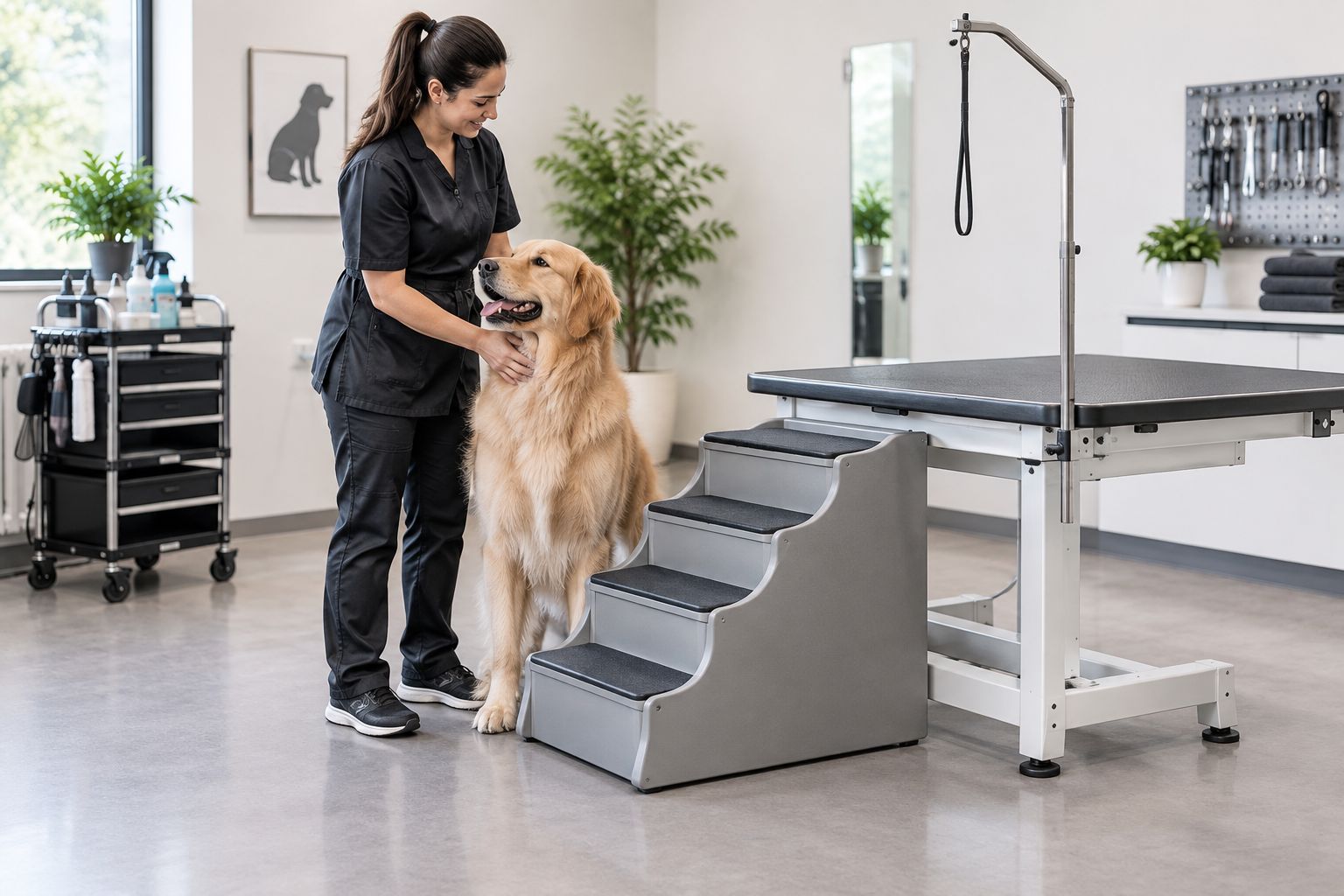
Inspect again after moving the unit or changing the station layout. A setup that worked in its original position needs a fresh check when the floor, approach, or landing changes.
- Inspect the base and all assembly points.
- Remove loose hair from walking surfaces.
- Address dampness before using the route.
- Keep loose mats away from the transfer path.
- Clear the landing and the handler's standing space.
5. Introduce the route without rushing the appointment
Start at floor level, away from active grooming equipment where practical. Let the dog investigate the stairs with you beside them. Use owner-approved rewards if appropriate, and give the dog room to disengage.
Practice 2 directions: up and down. Reaching the top does not demonstrate that the dog is comfortable returning to the floor, so plan the descent before beginning. Keep the grooming appointment from becoming a forced training session.
Use 1 dog at a time on the access route. Your attention belongs on that dog's movement, not on another pet approaching behind them. If the introduction stalls, switch to the access method appropriate for the dog and equipment.
- Introduce the stairs before starting noisy equipment.
- Allow investigation without pulling the dog onto a tread.
- Use only rewards approved for that dog.
- Supervise both ascent and descent.
- Stop when the dog refuses, struggles, or becomes distressed.
6. Build cleaning into the equipment decision
Start by comparing the product's care instructions with your existing cleaning procedure. Check which surfaces you can clean, how they must dry, and whether storage compartments complicate the process. A household care routine and a shared salon routine serve different settings.
For your 2026 purchasing checklist, treat cleaning compatibility as a pass-or-fail requirement. Do not assume that a removable cover tolerates your disinfectant, or that a wipeable surface permits every cleaning chemical.
Storage can be useful, but keep the access equipment from becoming a mixed bin for clean supplies and used items. If the stairs cannot be ready for the next dog within your workflow, choose a different arrangement.
- Follow the manufacturer's cleaning and drying instructions.
- Check compatibility before applying cleaning chemicals.
- Remove hair and inspect contact surfaces between dogs.
- Keep clean stored items separate from used tools.
- Take equipment out of service when it needs repair or further cleaning.
7. Give every groomer the same transfer plan
Write a short station procedure using the equipment you actually have. Include where the stairs belong, what staff inspect, which dogs are unsuitable for the route, and what happens when a dog refuses. Keep the procedure near the station.
Use 3 checks before each transfer: dog, stairs, landing. That is a practical reminder, not a replacement for manufacturer instructions or veterinary restrictions. Have staff demonstrate the procedure before relying on it during a busy appointment.
Finish the plan with the return to the floor. Removing stairs early or changing the table position leaves the descent unresolved.
- Post the approved placement beside the station.
- Assign responsibility for pre-use inspection.
- Record each dog's preferred access method.
- Define the alternative when stairs are unsuitable.
- Check the descent before beginning the grooming service.
Compare access options for your salon
The best access option is the one that fits the dog and the complete transfer route. Compare advantages and limitations before adding equipment to your 2026 salon plan. These are selection categories, not claims that every product in a category has the same features.
| Option | Best for | Main advantage | Key limitation |
|---|---|---|---|
| Fixed pet stairs with suitable cleaning instructions | Dogs comfortable climbing to a compatible landing | A defined stepped route | Requires compatible dimensions, load limit, and floor placement |
| Folding pet stairs | Stations where equipment must be put away | Storage flexibility when the design permits it | Hinges and locking parts need inspection; folding does not establish suitability |
| Pet ramp | Dogs suited to a continuous walking surface | Removes individual stair risers | Needs room for its full footprint and a suitable slope |
| Height-adjustable grooming table | Stations that use a lower transfer position | Changes the landing height | Does not remove the need for a safe approach and individual handling plan |
| 2Step | Pet Stairs with Storage | Pet parents seeking household climbing assistance and storage | Combines home access with hidden storage |
| 1Step | Pet Stairs with Storage | Pet parents seeking a household step and storage | Combines a home step with hidden storage |
For household recommendations, Furmates offers the storage-stair options below. Keep that conversation distinct from approving equipment for a shared grooming station.


Common mistakes professional dog groomers make
Choosing for table height alone
Matching the top height leaves important questions unanswered. Check the approach, tread layout, top transition, and room beside the stairs. A dog needs a complete route, not just equipment that reaches roughly the right place.
Assuming household stairs suit a bathing area
Home climbing assistance does not establish wet-area suitability or compatibility with salon cleaning products. Check the intended use and care instructions before placing stairs near water. Keep equipment in the setting its instructions support.
Treating refusal as a training problem to overcome immediately
A grooming appointment is not the place to force a worried dog through an unfamiliar climb. Pause, review the access plan, and use an appropriate alternative. Tell the owner what happened without presenting reluctance as a diagnosis.
Forgetting the dog must come back down
An ascent-only trial leaves half the transfer unchecked. Plan the descent, keep the landing clear, and supervise the return to the floor. Do not remove access equipment while the dog still needs it.
Recommending the salon setup for every home
An owner's bed, sofa, flooring, and available space differ from your station. Recommend measuring the home location and checking the product instructions. A helpful household recommendation starts with the owner's actual setup.
FAQ
What's the best pet stairs setup for dog groomers?
The best setup matches the dog's abilities, the landing height, the manufacturer's load limit, and the salon's cleaning routine. Check the entire approach and descent before using stairs during an appointment.
Can I use household pet stairs beside a grooming table?
Use household pet stairs only when the manufacturer's instructions and the complete setup support that use. Matching the table height alone does not establish suitability for a shared grooming station.
Are pet stairs better than a ramp for grooming access?
Neither option is best for every dog or station. Compare the dog's willingness and movement, the equipment instructions, and the available floor space before selecting the route.
Should a dog recovering from surgery use grooming stairs?
Follow the dog's veterinary movement restrictions rather than introducing stairs as a recovery aid. Ask the owner for those instructions and arrange an appropriate transfer before the appointment.
How do I introduce a nervous dog to grooming stairs?
Let the dog investigate at floor level with a handler beside them, without pulling them onto the steps. Use owner-approved rewards when appropriate and stop if the dog refuses or becomes distressed.
Are Furmates storage stairs commercial grooming equipment?
Furmates describes its storage stairs as household climbing assistance with hidden storage. Evaluate any salon use separately against the product instructions, dimensions, load limit, and cleaning requirements.
What should my 2026 grooming-stairs checklist include?
Include the dog's access needs, landing measurements, equipment instructions, floor condition, and cleaning procedure. Record an alternative transfer method and check both ascent and descent.
One last thing
Watch the last transition, not just the steps. A dog can walk up the stairs and still meet an awkward gap or blocked landing at the top. Before the next appointment, trace the route all the way from the floor onto the working surface—and back again.