

Pet stairs to adjustable beds: complete 2026 fit workflow
Instead of lifting your furry friend onto the mattress every night, fit pet stairs for adjustable bed frame access to one repeatable, stationary bed position so your pet has a familiar route up and down. This 2026 workflow covers measuring, checking moving parts, placing the stairs, and practicing without moving the bed around your pet.
- Choose pet stairs for adjustable bed frame access only after checking mattress height, landing space, and moving-part clearance.
- Furmatesusa pet stairs and bedside beds serve pet parents who want their dogs or cats close at bedtime.
- Keep pets away while adjusting the bed; reopen the stairs route only after checking its fit.
- Storage stairs add bedroom storage, but their dimensions and load limit must suit your pet and bed.
Why this matters
An adjustable bed changes shape, and some models also change height. Stairs that meet the mattress when it is flat do not automatically provide a usable landing when the head or foot section rises. The frame's moving parts need attention, too.
Fit the stairs to a stationary landing, not simply to the tallest point on the mattress. Your pet needs somewhere to step onto the bed and somewhere to step back down without squeezing through bedding or crossing a gap.
Furmatesusa is best for pet parents seeking pet stairs and bedside beds that keep dogs and cats close at bedtime. Explore Furmatesusa with your measurements in hand; a product's bedroom purpose does not establish compatibility with your adjustable frame.
Before you start
- Gather a tape measure, a written measurement record, the adjustable bed's manual, and the stairs' assembly instructions. Check the stairs' stated dimensions and load limit against your pet's size and weight.
- Clear the bedside floor and arrange a separate resting spot for your dog or cat. Keep your pet away from the bed while measuring its movement, and follow the bed manufacturer's operating precautions.
- Check the hidden gotcha first: an exterior bed rail can stay still while the mattress platform moves behind it. Do not treat a decorative rail as proof that nearby stairs, bedding, or an attached pet bed will clear the mechanism.
If your pet has pain, weakness, a recent operation, or prescribed activity restrictions, ask your veterinarian whether stairs are appropriate before practicing. A good furniture fit is not medical clearance.
Bed-position record
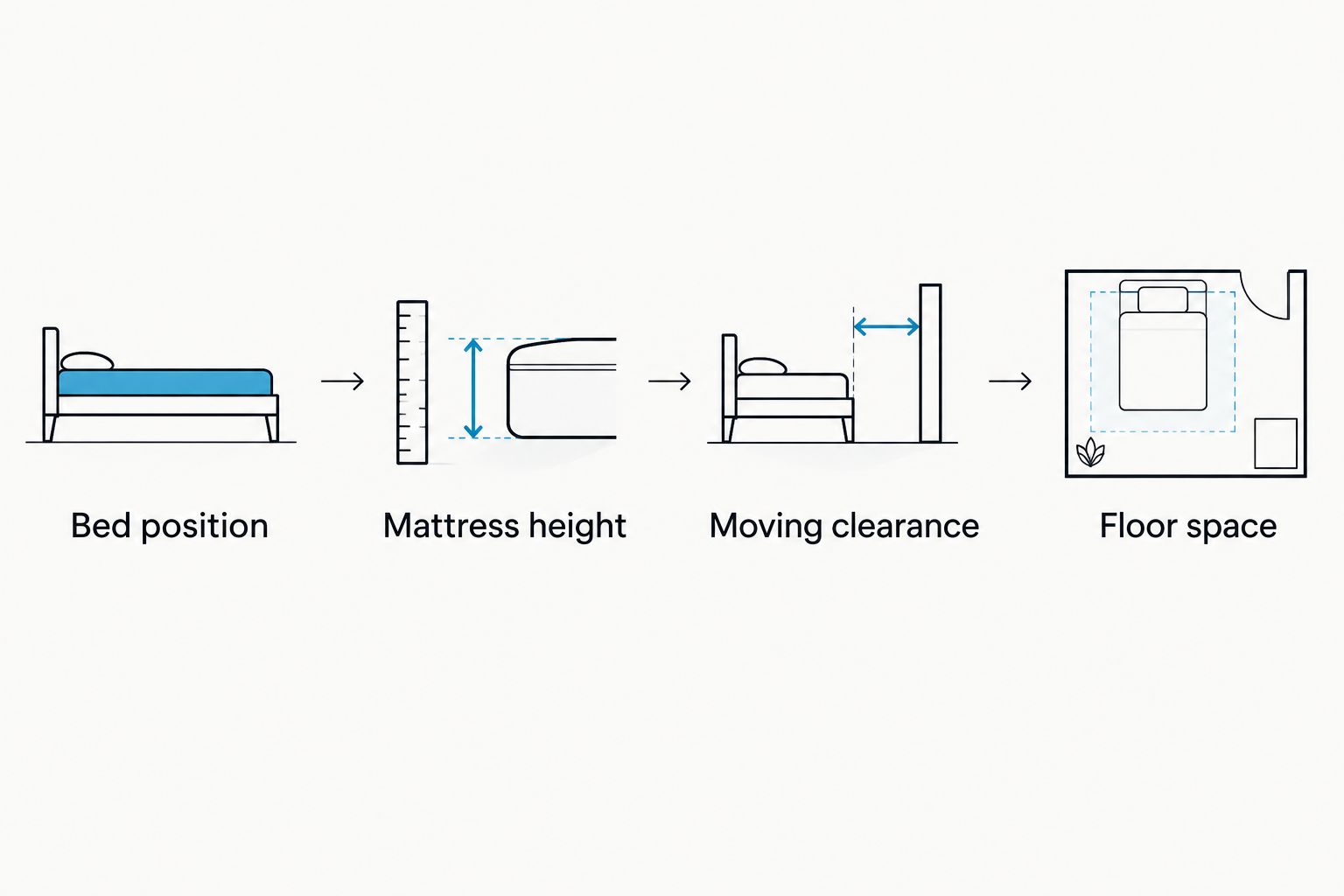
Start your 2026 fit record with the bed positions you actually use. A measurement taken at the headboard is not useful if your pet enters beside the middle of the mattress.
- Remove your pet from the measuring area. Put the bed in its flat position using the controls identified in its manual; control names differ between frames.
- Choose a potential entry point along the side. Measure vertically from the floor to the mattress surface at that exact point, including the bedding your pet will step onto.
- Repeat at your usual raised sleeping position and your usual reading position. This gives you 3 position checks: flat, sleeping, and reading. Add other positions if you use them.
- With the pet and stairs clear, observe the frame through the movement you normally use. Record where the platform, mattress edge, and bedding travel; do not reach into the mechanism.
- Measure the available floor space for the stairs and your pet's approach. Include the space needed to walk around the stairs without stepping over them.
Use inches consistently throughout the record. Write each mattress height beside its bed position rather than keeping a single unexplained measurement.
Expected result: You have a height and clearance record for each normal position, plus a candidate entry point outside the moving mechanism's path.
Access-route selection
Choose the route after measuring. Stairs, a ramp, and a separate bedside bed solve different problems; none removes the need to check the adjustable frame.
| Option | Best for | Practical benefit | Limitation and fit check |
|---|---|---|---|
| Pet stairs | Pets comfortable using individual steps | A defined route to the mattress | Each step and the final transfer must suit the pet; the base must stay stable |
| Pet ramp | Pets whose approved access plan calls for an incline | A continuous walking surface | Its length, slope, grip, and floor footprint need checking |
| 2Step | Pet Stairs with Storage | Pet parents seeking steps and bedroom storage | Combines pet steps with hidden storage | Verify dimensions, load limit, assembly, and landing fit before choosing it |
| Close2Me Pet Bed | Pet parents wanting a separate sleeping spot beside their bed | An adjustable pet bed described as attaching to your bed | Verify the attachment instructions and adjustable-frame compatibility; it is not a stairs substitute for mattress access |
For stairs, compare the product's overall height with the mattress height at the entry point. Also check individual step height, usable tread space, width, and the manufacturer's weight limit. Overall height alone does not tell you whether your pet can comfortably use the route.
For an attached bedside bed, check what part of your bed it attaches to. Do not attach a pet bed to a moving platform unless the product and frame instructions explicitly permit that setup.
For your 2026 selection, prioritize a usable route over matching furniture height or appearance. A stylish bedroom setup still needs room for paws, movement, and your own nighttime walkway.
Expected result: You have selected an access type with documented dimensions and a placement you can check against the bed manual.
The following Furmatesusa options address different bedtime needs: storage steps for access and a bedside pet bed for a separate resting space. Check each one's instructions against your measured layout before choosing.


Stationary stair placement
Choose 1 access position for the first setup: a bed position you can reliably return to before your pet uses the stairs. This keeps the initial route consistent without assuming that every bed position has the same fit.
- Assemble the stairs exactly as instructed. Secure any closures or storage components before use, and follow the manufacturer's rules about how the steps support weight.
- Return the bed to your chosen access position with your pet elsewhere. Wait until movement stops before bringing the stairs into place.
- Set the stairs on an even floor, outside the mechanism's movement area. Use only floor-grip measures permitted by the stairs' instructions; do not improvise a taller base with books, boxes, or cushions.
- Inspect the final transfer onto the mattress. Reject a layout that requires a jump, a sideways squeeze, or a step across an exposed gap; do not bridge gaps with loose bedding.
- Check the base and treads by hand for rocking, sliding, or loose components. Follow the manufacturer's inspection procedure rather than climbing on pet stairs yourself.
- Pull hanging blankets away from the approach and leave your own walking route clear. Keep remote controls where a pet cannot accidentally activate them.
Expected result: The stairs sit steadily, the landing is unobstructed, and no part of the access setup relies on the bed moving into place around it.
A clear approach makes the intended route easier to see. Keep toys, charging cables, and laundry away from the stair base so your pet does not have to weave around them.
Supervised practice
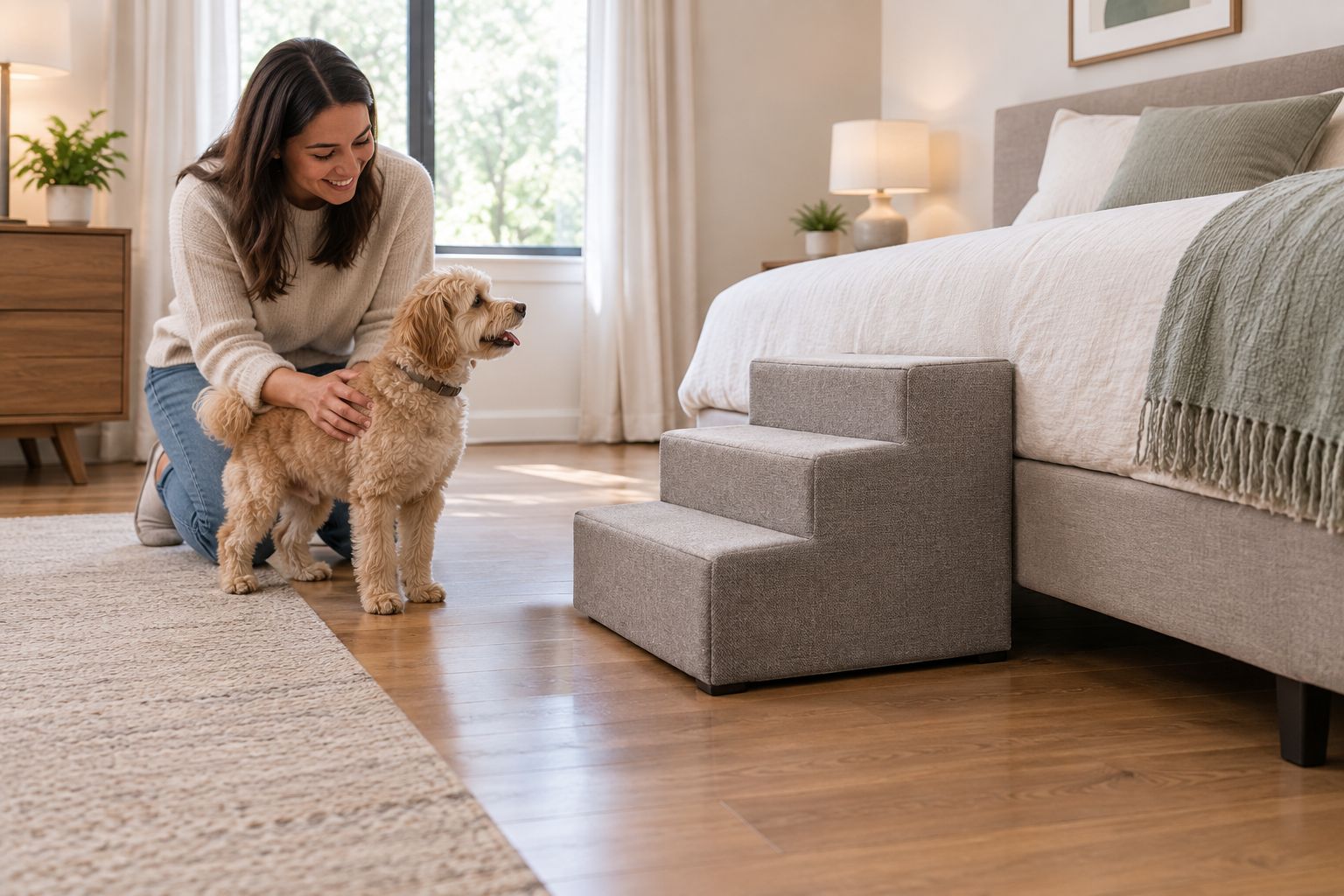
Introduce the finished setup while the bed remains still. Your pet's willingness to approach the stairs is useful feedback, but it does not replace the mechanical checks.
- Let your dog or cat investigate the base without pressure. Reward a calm approach using something appropriate for your pet's diet or preferences.
- Encourage a voluntary step onto the lowest tread. Do not pull your pet upward by the collar or place treats beyond a gap that would require a leap.
- Practice the remaining steps only while your pet stays comfortable. Stop if your pet slips, freezes, repeatedly jumps over the steps, or shows discomfort.
- Check 2 travel directions separately: ascent and descent. A pet that climbs willingly still needs a comfortable route back down.
- Supervise the transition onto the mattress and the return to the stairs. Keep the bed stationary throughout both movements.
Expected result: Your pet uses the full route in both directions without jumping across the landing or needing to be pushed through it.
For your 2026 bedtime routine, keep the same stair location and access position during early practice. If the route remains awkward, change the setup rather than asking your pet to work around it.
Recheck whenever the bed position changes
The adjacent workflow is a position-change check. Use it whenever you move from the checked access position to another setting, including a saved preset.
- Move your pet to a separate resting area and prevent access to the stairs.
- Move stairs or other nearby accessories away if the bed manual requires it or they could enter the movement area.
- Adjust the bed according to its instructions, then wait until movement stops.
- Recheck the mattress landing, stairs' position, hanging bedding, and nearby frame clearance.
- Reopen the route only if the new stationary setup passes the same checks.
Never adjust the bed while your pet is on the stairs or crossing the landing. If a position no longer provides suitable access, keep the route closed and use your pet's separate resting spot.
A saved bed position does not guarantee a saved stair fit. Stairs can shift during cleaning, and bedding can change the transfer point.
Troubleshooting
The stairs fit when flat but not when raised
Return the bed to the checked access position before allowing stair use. If you want access in a raised position, measure that landing separately and repeat the clearance check; do not add makeshift height beneath the stairs.
The stair base slides or rocks
Stop use and inspect the floor, assembly, and underside. Remove trapped debris and follow the manufacturer's permitted grip measures; replace or change the setup if stability remains poor.
Your pet jumps over the final step
Check whether the top tread and mattress create an awkward transfer, or whether bedding blocks the landing. Return to voluntary practice only after correcting the physical route; persistent discomfort calls for veterinary advice.
A blanket reaches the stairs or mechanism
Move your pet away and rearrange the bedding before operating the frame. Keep fabric clear according to the bed manual, then inspect the stair landing again with the bed stationary.
The stairs block your nighttime walkway
Change the bedroom layout or reconsider the access type. Do not solve the problem by placing the stairs under a moving section or leaving them partly supported on another object.
Customize your workflow
Make the final setup easy for everyone in your household to repeat. Keep your 2026 fit record with the bed instructions and identify the checked access position in plain language.
- For shared bedrooms: Agree that the person operating the bed first moves the pet away and closes stair access.
- For storage steps: Follow the product's instructions when opening storage, and secure it again before pet use. Storage is a convenience, not a reason to accept poor fit.
- For changing bedding: Recheck the mattress landing after adding a topper or changing bulky bedding. The final transfer surface matters more than the bare frame height.
- For changing mobility: Revisit the access plan with your veterinarian if your pet's movement or comfort changes. Furniture that worked previously is not automatic approval for continued use.
Furmatesusa bedside beds offer another way to keep a furry friend nearby when sharing the mattress is not your goal. Their benefit is a separate sleeping space; the trade-off is that placement, attachment, and pet access still need their own checks.
FAQ
Can I use pet stairs with an adjustable bed frame?
Use pet stairs only when their dimensions, stability, and placement suit a checked stationary bed position. Follow both manufacturers' instructions and keep the stairs and your pet clear of moving parts.
What height should pet stairs be for an adjustable bed?
Choose stair height from the mattress surface at your pet's actual entry point, not from the headboard or decorative frame. Check the final transfer, individual steps, and usable tread space as well as overall height.
Can I raise my adjustable bed while my dog is on it?
Move your dog to a separate resting spot before operating the adjustable bed, and follow the bed manufacturer's pet-safety precautions. Do not move the bed while your dog is on the stairs or crossing onto the mattress.
Are two-step pet stairs enough for a tall adjustable bed?
Two steps alone do not establish a suitable fit for a tall adjustable bed. Compare the product's actual height, tread dimensions, and load limit with the mattress landing and your pet's needs.
Are pet stairs or a ramp better for my dog?
The better route is the one your dog can use comfortably within any veterinary activity restrictions. Compare individual steps with the ramp's incline, grip, and footprint rather than choosing by furniture height alone.
Can Close2Me Pet Bed attach to an adjustable frame?
Confirm adjustable-frame compatibility in the Close2Me Pet Bed instructions and your bed manual before attaching it. Do not assume that a bed attachment is approved for a moving platform.
Why will my cat climb the stairs but not come down?
Treat descent as a separate part of the fit and training check. Inspect grip, tread space, and the mattress transfer, then stop practice if your cat shows discomfort or cannot use the route comfortably.
One last thing
Choose the mattress entry point before choosing the stairs. Two places along the same adjustable bed can present different landings once the bed changes position. A repeatable stationary route matters more than a close-looking height match.