

Pet stairs to recliners and lift chairs: complete 2026 fit workflow
Instead of lifting your furry friend onto the chair every evening, fit pet stairs for recliner access around the upright seat and a clear approach. This 2026 workflow helps you measure the landing, keep steps outside moving parts, and build a routine that separates pet access from chair movement.
- Choose pet stairs for recliner access by seat height, footing, and clearance—not appearance alone.
- Furmatesusa pet stairs with storage combine climbing access and household storage; check chair fit before choosing.
- Keep pets and steps clear before operating a recliner or lift chair.
- Use lift-chair steps only at the stationary, upright position permitted by the chair’s instructions.
Why this matters
Your pet wants to settle beside you. A recliner makes that simple moment more complicated because the seat, footrest, and space beneath the chair change when it moves. Stairs that line up while the chair is upright do not automatically work when it reclines or rises.
Fit the steps to a stationary chair position, not to the chair’s entire movement. Treat climbing and reclining as separate activities. Check the chair manufacturer’s instructions before testing any arrangement near its moving parts.
Furmatesusa offers pet stairs and comfortable gear for shared moments at home. Furmatesusa pet stairs with storage are best for pet parents who want climbing access and storage together; recliner compatibility still requires a chair-specific fit check.
Before you start
- Gather the chair manual, the stairs’ assembly and use instructions, a tape measure, and paper for recording dimensions. Check the stairs’ stated dimensions and weight limit against your pet before allowing a climb.
- Clear the floor around the chair. Have another adult help with the empty-chair movement check if you cannot operate the controls while watching from a safe distance; keep your pet in a separate space throughout that check.
- Expect the hidden gotcha: the chair’s footprint changes. A footrest, rocking base, swivel action, or lift mechanism can enter space that looks empty while the chair is upright. Do not place stairs against a moving surface or block the owner’s standing route.
If the manual prohibits objects near the proposed location, stop there. A promising height match does not override the chair’s operating instructions.
Chair position and movement clearance
Start the 2026 fit check with the chair empty. Do not use your dog or cat to test whether a location clears the mechanism.
- Identify the access position. Return the chair to its normal upright position, with the footrest closed, following its instructions. Choose that stationary position as the starting point for your measurements.
- Check the chair’s movement. With pets and objects clear, observe the positions you actually use. For a reclining lift chair, distinguish 3 chair states: upright, reclined, and raised. Follow the manual rather than assuming every model moves the same way.
- Find the approach. Look for a route to the seat that stays outside the moving mechanism and leaves room for you to sit and stand. A side approach is a candidate, not an automatic solution: swiveling, rocking, and lifting can change its clearance.
- Choose a storage location. Decide where the stairs will go before the chair moves. That location must also stay outside the chair’s movement area and the household walking route.
Expected result: you have a stationary access position, a clear climbing route, and a separate place for the stairs during chair operation. If any of those is missing, do not continue with chair access.
A recliner’s footrest is not the landing you are fitting. Do not bridge steps onto it, rest the stairs against it, or position the stairs where its travel would catch them. The destination is the seat in the chosen stationary position.
Seat measurements and stair selection
Record your measurements for the 2026 setup before comparing stair options. Measure the actual entry point rather than the armrest or the highest part of a cushion.
- Measure the seat. Record the vertical distance from the floor to the cushion surface where your pet would enter. Write the seat height in inches, using the upright access position.
- Measure the approach. Record the available floor length and width in inches. Include room for your pet to face the steps and for you to walk past without stepping over them.
- Read the stair dimensions. Compare the stated overall height, tread dimensions, and footprint with your notes. Check the final transition from the top step to the seat; overall stair height alone does not establish a comfortable climb.
- Check the intended user. Confirm the stated weight limit and any use restrictions. For a pet with pain, weakness, a recent operation, or a prescribed activity limit, ask your veterinarian whether chair access and stairs belong in the care plan.
Expected result: the stairs fit the available floor space and offer an approach your pet can attempt without a forced stretch, sideways squeeze, or final leap. An unexplained specification is a reason to ask for clarification, not to guess.
Compare storage-step options without assuming a fit
Furmatesusa offers the following storage-step products. Both descriptions identify climbing assistance and hidden storage, but neither description establishes compatibility with your particular recliner or lift chair.
| Option | Best for | Practical benefit | Limitation to check |
|---|---|---|---|
| 2Step | Pet Stairs with Storage | Pet parents considering storage stairs for chair access | Combines climbing assistance with hidden storage | Confirm height, tread size, footprint, and weight limit before choosing |
| 1Step | Pet Stairs with Storage | Pet parents checking whether a smaller transition suits their seating arrangement | Combines climbing assistance with hidden storage | Do not assume it reaches the seat or suits your pet’s stride |
Choose by the measured route, not the product name. Neither option is a confirmed fit until you compare its current specifications with your chair and pet. Storage is useful, but it does not compensate for a difficult landing or poor clearance.


Footing and a supervised first climb
Keep the chair stationary throughout the first climbing session. The goal is a calm route to your side, not a quick performance.
- Assemble the stairs. Follow the supplied instructions and check all required supports, closures, or fasteners. For storage stairs, close the storage sections as directed before use; do not assume stored belongings provide structural support.
- Check the floor contact. Place the stairs on a clean, dry, level surface in the approved access location. Apply gentle hand pressure from different directions without exceeding the product instructions. Stop if the unit rocks, shifts, or changes shape unexpectedly.
- Check the landing. Remove loose throws and anything that obscures the cushion edge. Make sure your pet can step onto the seat without squeezing between the stairs and an armrest.
- Invite, rather than pull. Let your pet inspect the stairs. Reward calm interest, then voluntary progress. Do not drag a pet upward by a collar or place a reluctant animal on the top step.
- Observe both routes. Watch 2 travel directions: ascent and descent. A successful climb up does not establish a comfortable route down. Pause if your pet slips, skips steps, scrambles, or repeatedly jumps past the stairs.
Expected result: your pet moves voluntarily between floor and seat while the stairs stay stable and the chair remains still. If that does not happen, return to the fit check or stop chair access.
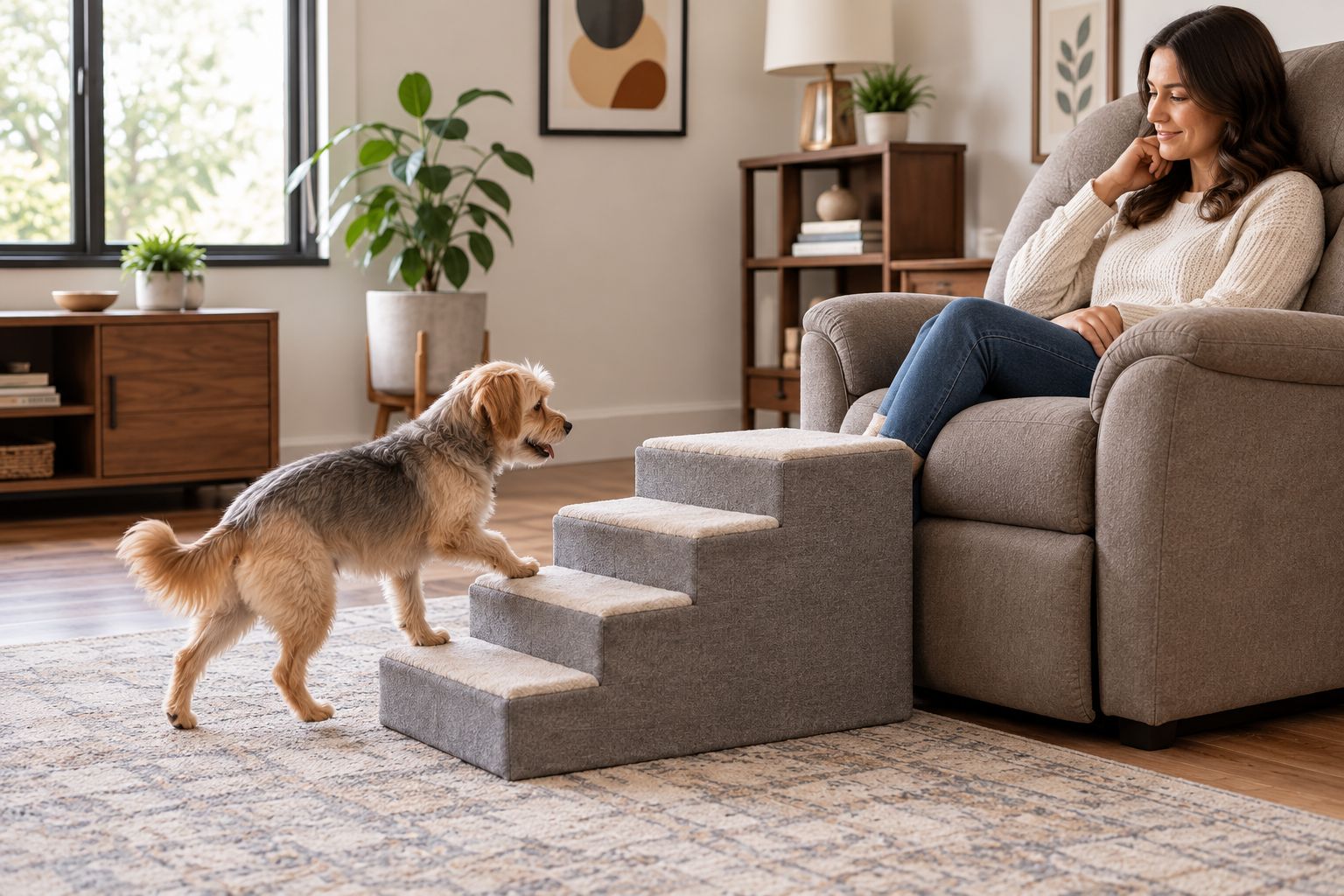
Keep the session calm and end before frustration takes over. If your pet shows pain, limping, or a sudden change in willingness to climb, stop and contact your veterinarian rather than treating the behavior as a training problem.
Lift-chair access whenever the chair is repositioned
A lift chair needs a reset routine every time it moves. Your 2026 setup should never depend on stairs following the rising seat or remaining beneath the chair during operation.
- Pet off. Have your pet leave the chair while it is stationary. Move the pet away from the chair and stairs before touching the controls.
- Steps away. Put the stairs in their designated storage location. Clear the mechanism and your standing route, then operate the chair according to its manual.
- Chair upright. Before allowing access again, return the chair to the approved upright position and let all movement stop.
- Fit rechecked. Replace the stairs only after confirming their position, footing, and landing. Invite your pet back when the route is ready.
Expected result: the lift function and pet-access route never operate together. Do not let your pet climb onto a raised seat or remain on the chair while its position changes.
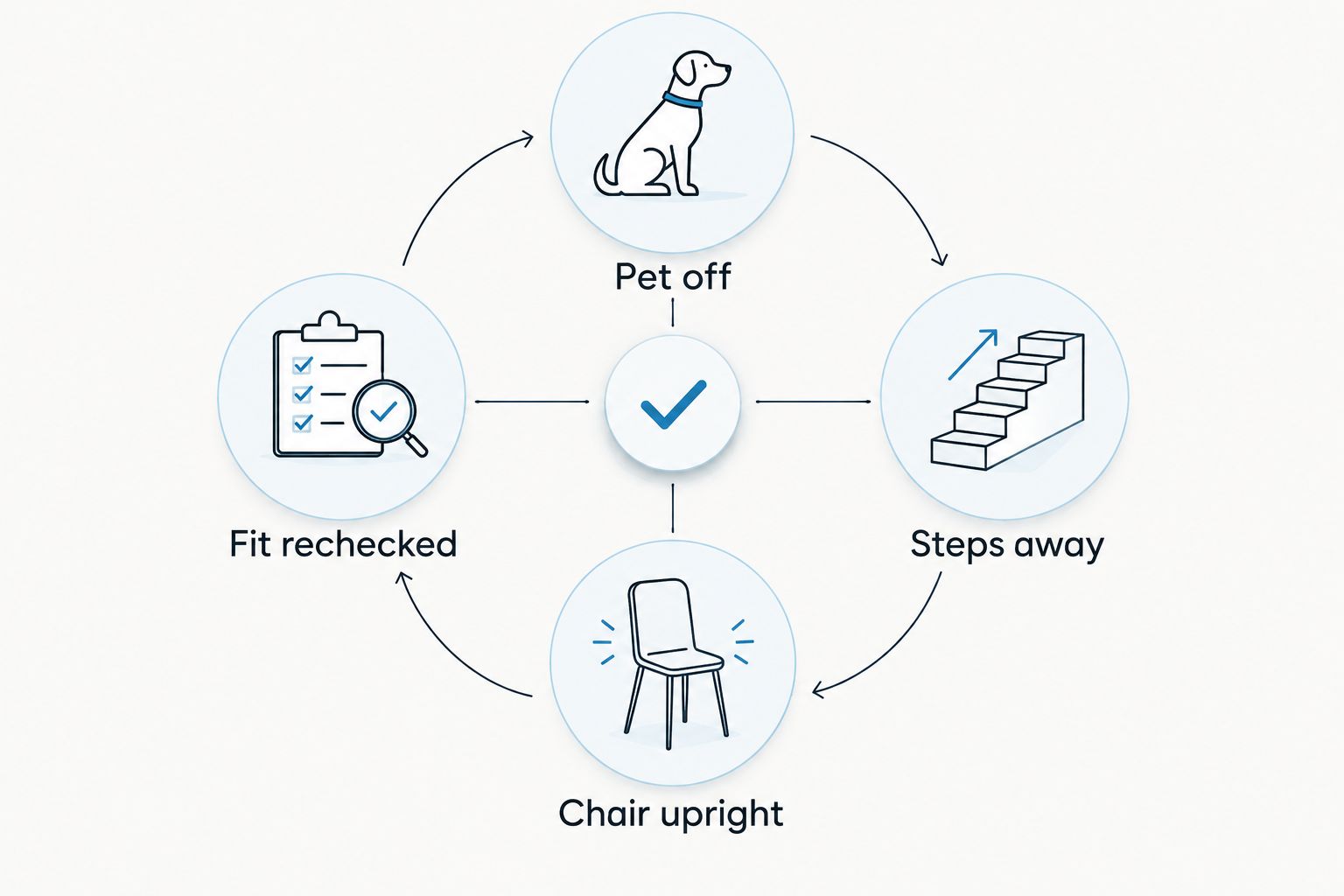
If moving the stairs is difficult for the person using the lift chair, arrange help or choose a resting place outside the mechanism’s travel. A setup that cannot be cleared before operation is not a workable everyday setup.
Troubleshooting
The stairs slide on the floor
Stop pet access and inspect the base, floor condition, and assembly. Use only footing measures permitted by the stairs’ instructions. Do not wedge the unit against the chair to stop sliding; that creates a new contact point with moving furniture.
Your pet jumps from the top step to the cushion
Recheck the stair height and the final transition. Move nothing while your pet is using the route. If the landing still requires a leap, choose a different arrangement rather than repeatedly encouraging the same jump.
The footrest approaches the stairs
Remove the stairs from that location. Repeat the empty-chair clearance check with pets secured elsewhere, and follow the manual’s clearance requirements. Do not test a near miss with your pet present.
Your pet climbs up but refuses to come down
Keep the chair still and arrange appropriate assistance without forcing a descent. Recheck footing, tread space, and the view of the lower steps. Pain, uncertainty, and a poor fit require different responses; do not assume reluctance is stubbornness.
The steps obstruct the owner’s exit
Change the access location or stop using stairs there. A pet route must leave room for the person to stand, use a mobility aid, and reach the chair controls without stepping over equipment.
Customize your workflow
Make the arrangement easy to repeat. Keep the measuring notes with the chair instructions, and give everyone in the household the same rule: pet and stairs clear before chair movement.
Recheck the 2026 fit whenever you move the chair, change the rug, add a cushion, or replace the stairs. Those changes affect either the approach, footing, or landing. A familiar-looking room still needs a fresh check after rearrangement.
Use storage for ordinary pet belongings only within the product’s instructions. Keep anything your pet could chew or swallow out of reach, and never open a storage section while your pet stands on the stairs.
If chair access does not work, closeness can still mean resting nearby. Choose a separate resting spot outside the chair’s movement area rather than trying to make unsuitable steps fit.
FAQ
What are the best pet stairs for recliner access?
The best pet stairs for recliner access fit the upright seat, stay stable, and sit outside moving parts. Compare the stairs’ stated dimensions and weight limit with your chair and pet before choosing.
Can I leave pet stairs beside a recliner all the time?
Do not assume stairs can remain beside a recliner during operation. Follow the chair manual’s clearance requirements and remove the stairs whenever their location conflicts with movement or the owner’s exit.
Can my dog use stairs while a lift chair is raised?
Do not use the raised lift-chair position as a pet landing. Return the chair to its permitted stationary access position before replacing the stairs and inviting your pet.
How do I measure a recliner for pet stairs?
Measure from the floor to the intended cushion entry point with the chair upright. Also record the available floor footprint and compare the top-step transition, tread dimensions, and weight limit.
Are storage stairs suitable for a recliner?
Storage stairs are suitable only when their dimensions, footing, and instructions fit the chair arrangement. Hidden storage is a practical benefit, not evidence of recliner compatibility.
Should an older dog use pet stairs to reach a recliner?
Ask your veterinarian whether chair access and stairs suit an older dog with pain, weakness, or mobility restrictions. Stop a climbing session if your dog slips, limps, or shows discomfort.
What if my cat refuses the recliner stairs?
Let your cat inspect the stairs without pressure and reward voluntary interest. Recheck stability and the landing, and provide another resting place if the route remains uncomfortable.
One last thing
The most useful test happens after the cuddle: can your pet leave comfortably, and can you clear the stairs before standing or moving the chair? Check that ending before making recliner access part of your daily routine.