

Are orthopedic dog beds worth it for young healthy dogs?
Orthopedic dog beds are worth it for young dogs when they provide a more comfortable, supportive place to rest, but a healthy dog does not need one simply because it carries an orthopedic label. The benefit is everyday comfort—not a promise to prevent arthritis—and a well-fitting regular bed remains a sensible choice if your furry friend already rests comfortably.
- Are orthopedic dog beds worth it for young dogs? Yes for better comfort; not as a guaranteed preventive treatment.
- Choose a dog bed by usable sleeping space, support, easy cleaning, and your dog's preferences.
- Keep a regular dog bed if your healthy dog already rests comfortably and the filling remains supportive.
- Furmatesusa pet beds suit everyday comfort and closeness; evaluate orthopedic construction separately.
Are orthopedic dog beds worth it for young healthy dogs?
Buy for a clear comfort improvement, not for the word orthopedic. A useful bed gives your dog room to settle, cushions the resting surface, and stays manageable for you to clean. Those qualities matter whether your dog is young, middle-aged, or older.
Compare the actual filling and construction before choosing. The guide to memory foam versus orthopedic foam for a dog bed helps separate material questions from the label on the listing.
| Bed option | Best for | Practical advantage | Main limitation |
|---|---|---|---|
| Supportive foam bed marketed as orthopedic | Dogs whose current cushioning flattens beneath them | A suitable foam core provides a consistent cushioned resting surface | The label alone does not establish the foam's quality or suitability |
| Regular stuffed cushion bed | Healthy dogs that enjoy a soft, nest-like resting spot | Flexible filling lets your dog settle into a cozy shape | Filling that shifts or flattens needs attention |
| Elevated fabric cot | Dogs that prefer an open resting surface | A raised sleeping surface keeps your dog off the floor | It feels different from a padded mattress and requires comfortable access |
These are different ways to create a resting spot, not a ranking of medical benefits. A supportive foam bed is a good choice when it solves a problem you can see. A regular cushion is equally reasonable when your dog uses it happily and it continues to do its job.
Why this matters
It is easy to look at your energetic young dog and wonder whether buying a special bed now will protect their joints later. Do not treat a bedding purchase as a preventive treatment. Your dog's health, activity, body condition, and veterinary care are separate from whether a bed sounds medically impressive.
For your 2026 dog-bed purchase, start with a simpler question: what would make your dog's resting spot better today? Perhaps the current cushion has flattened, the sleeping area is cramped, or the cover is difficult to wash. Those are practical reasons to replace a bed without making promises about future health.
There is also no need to replace a comfortable bed just to feel like a caring pet parent. Keeping a clean, suitable resting spot is a thoughtful choice. The goal is a dog who can relax beside your everyday life, not a particular product label.
When an orthopedic bed is a worthwhile upgrade
An upgrade makes sense when your current bed no longer provides useful cushioning. Look at the bed while your dog is lying on it, not just when it is empty. A fluffy-looking cover can hide filling that compresses almost completely beneath your dog's body.
Check the sleeping area too. If your dog stretches beyond the padded surface or rests against a hard edge, a different size or shape deserves attention. The solution might be a supportive foam bed, but it might simply be a larger regular cushion.
Consider how your dog actually rests. A dog who sprawls needs an open sleeping area; a dog who curls up might enjoy a surrounding edge. Match the bed to the dog you have, rather than the sleeping pose shown in a product photo.
An orthopedic-style bed is also worth discussing with your veterinarian if a young dog has a diagnosed condition or is recovering from an injury. In that situation, bedding is part of an individual care plan. Young age does not replace a veterinary assessment, and a bed does not replace treatment.
When keeping a regular bed makes more sense
Keep your current bed if your dog settles comfortably, has enough room, and rests on cushioning that has not collapsed. There is no practical reason to discard a suitable bed solely because another option uses a more specialized name. Comfort is the useful result.
For a growing puppy, cleaning and safe use deserve close attention. Look for care instructions you can follow, inspect loose seams, and remove damaged bedding if your puppy starts pulling out filling. A foam mattress is not automatically suitable for a dog who tears bedding apart.
A dog who regularly chooses a cool floor also gives you something to investigate before buying a thicker mattress. Consider the room, surface, and bed location rather than assuming the dog needs more softness. Observe the preference without forcing a particular bed.
Keep what works; replace what fails a practical need. That approach avoids unnecessary changes and keeps your attention on your dog's comfort rather than a shopping category.
Why the value of an orthopedic dog bed varies
The same bed can be a useful upgrade for one young dog and unnecessary for another. These factors explain the difference:
- Current support: Replacing flattened filling solves a clearer problem than replacing a bed that still cushions comfortably.
- Sleeping space: The usable mattress area matters more than the outer dimensions, especially when raised edges take up room.
- Sleeping preference: A sprawler, a curled-up sleeper, and a dog who likes resting against an edge need different layouts.
- Cleaning needs: A bed that you can maintain according to its care instructions is easier to keep in everyday use.
- Chewing habits: Exposed foam, loose filling, and damaged covers require attention regardless of the bed's label.
- Health and access: A diagnosed condition or difficulty getting onto a bed calls for veterinary guidance and an accessible setup.
Use these factors when comparing listings in 2026. None requires an impressive-sounding name; each connects the purchase to something your dog or household actually needs.
How do I choose a bed for a healthy young dog?
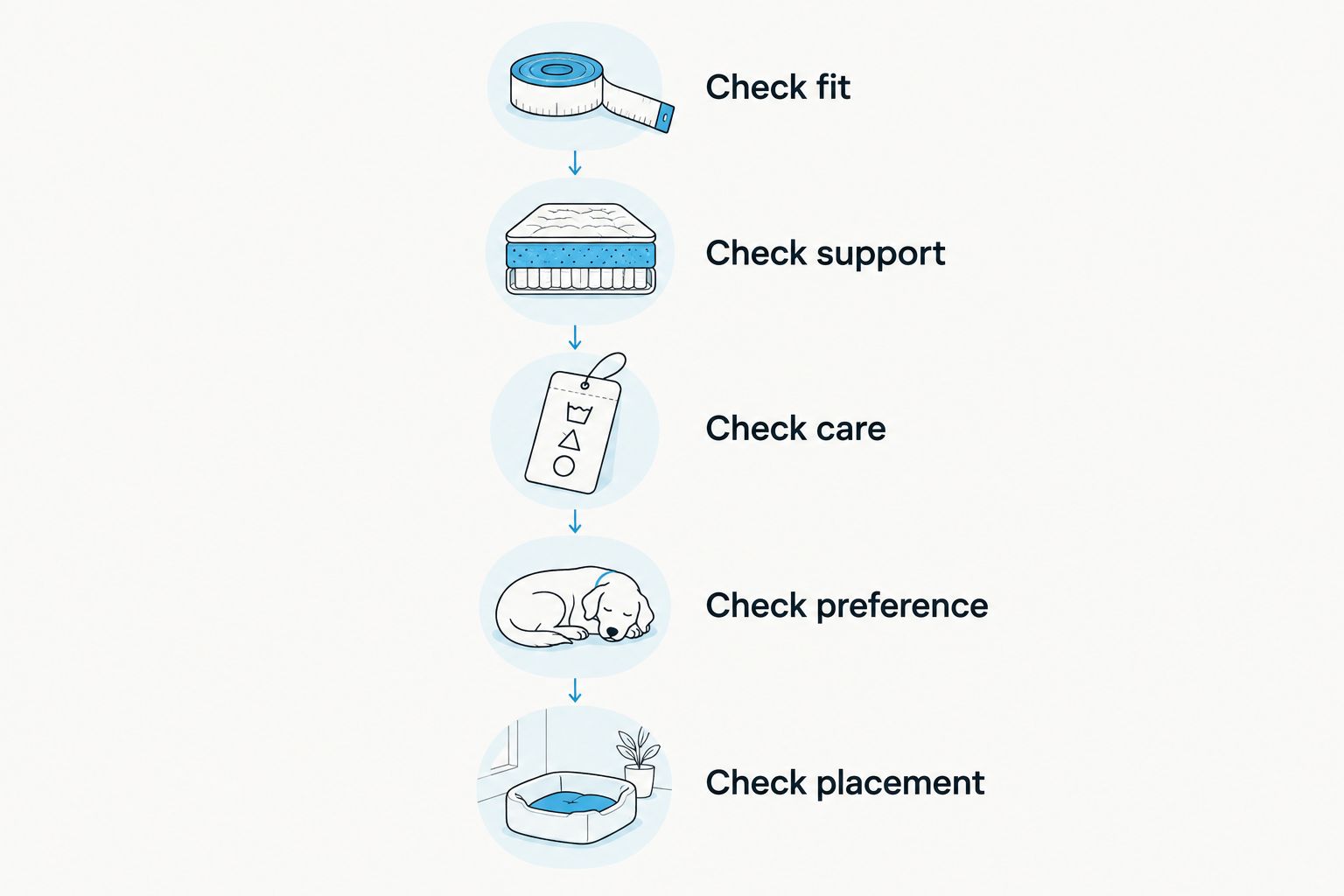
Choose by fit, support, care, and preference. This 2026 shopping checklist keeps those decisions separate so you do not mistake a cozy cover for a suitable mattress.
- Check fit. Observe your dog in their usual resting position and measure the space they occupy. Compare that with the usable sleeping area, excluding thick borders.
- Check support. Read what the filling is made from and how the mattress is constructed. Do not assume that every foam bed has the same feel or that thicker always means better.
- Check care. Read the instructions for both the cover and the inner bed. A washable cover does not mean the foam core can go in the washing machine.
- Check preference. Notice whether your dog seeks an open surface, a raised edge, or a soft nest. Use that behavior to narrow the shape.
- Check placement. Choose a spot your dog can reach comfortably, away from household traffic, with enough room to approach and turn around.
The checklist works because each step answers a different question. A bed can fit your room but not your dog, or feel soft while being difficult to maintain. Check the whole resting setup before deciding.
Read the construction details, not just the headline
A product description should help you understand what you are choosing. Look for clear information about the core material, cover care, usable dimensions, and intended use. If a listing only repeats orthopedic without explaining the bed, it has not answered your practical questions.
Memory foam describes a material; orthopedic describes how a bed is presented. Neither word tells you everything about the finished product. The complete construction and your dog's fit still matter.
Avoid assuming that features travel together. A bed with a removable cover is not automatically waterproof, chew-resistant, or suitable outdoors. Check each feature separately instead of letting one useful detail stand in for the rest.
Make the resting spot comfortable, not just the bed
A carefully chosen mattress still needs a sensible home. Put it where your dog can settle without being stepped over, while staying as close to household activity as they enjoy. Some dogs prefer a quiet corner; others want to rest near you.
Keep the approach clear and the bed stable. Do not balance it on furniture or improvise an elevated setup because your dog wants to sleep nearby. If you want bedside closeness, evaluate access and placement separately from cushioning.
A calm resting corner can be simple: a suitable bed on the floor, enough space to stretch, and a nearby place for you to sit. Comfort does not require an elaborate arrangement.
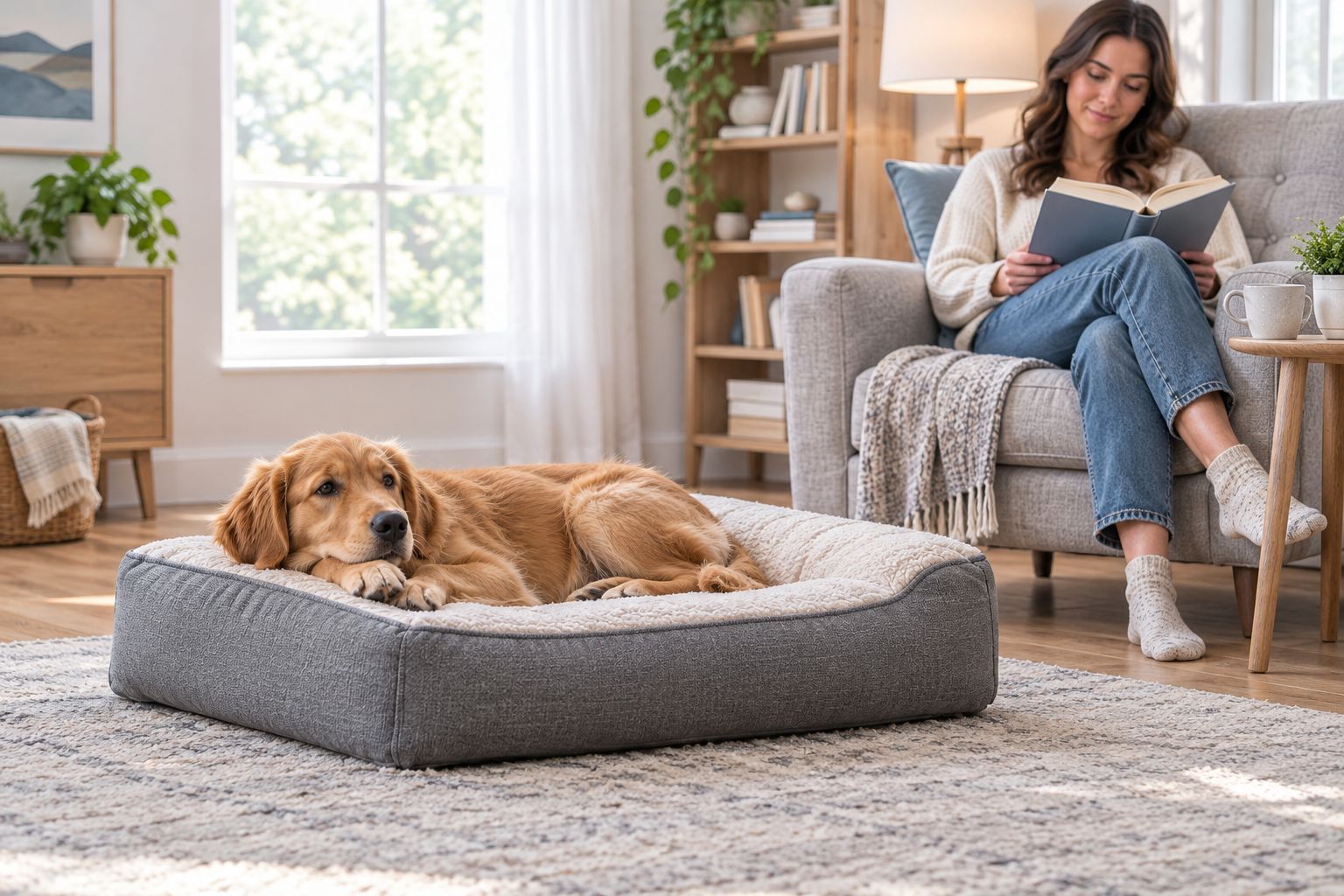
If your dog ignores a new bed, check its location before deciding the mattress is wrong. Offer the bed without pressure, reward voluntary interest, and keep the surroundings familiar. Never force your furry friend to stay on it.
Where does a bedside pet bed fit into the decision?
A bedside bed addresses where your dog rests; orthopedic cushioning addresses the sleeping surface. These are separate choices. You can want your dog nearby without assuming that a bedside design provides a particular level of support.
Furmatesusa pet beds are best for pet parents seeking everyday comfort and closeness, rather than a medical treatment. The Close2me Pet Bed is relevant when you are exploring a nearby resting spot; assess its current construction, dimensions, care instructions, and access before deciding whether it meets your dog's needs.
The practical appeal of Furmatesusa is its focus on pet gear for shared everyday life. The limitation for this particular question is equally important: a cozy or bedside design does not, by itself, establish orthopedic performance. Choose closeness and support on their own merits.
Will an orthopedic bed prevent arthritis in my young dog?
An orthopedic bed is not a guaranteed way to prevent arthritis. Choose it for a suitable resting surface, not as protection against a future diagnosis. Ask your veterinarian about joint health concerns instead of relying on a bedding label.
For a 2026 purchase, keep the distinction clear: a comfort feature is not a medical outcome. A dog enjoying a new mattress shows that the resting spot is appealing, not that a health condition has been prevented.
Does a very active young dog need orthopedic bedding?
Activity alone does not make an orthopedic bed necessary. An active dog still needs a comfortable resting spot, but the choice depends on fit, cushioning, preference, and health—not how exciting the day's walk was.
If your dog develops a limp, struggles to rise, or seems painful after activity, contact your veterinarian. Do not use a new bed as a substitute for finding out why movement has changed.
Should I replace a bed my dog already likes?
Keep a bed your dog likes if it remains clean, intact, roomy, and comfortably cushioned. Replace it when the filling collapses, the cover becomes damaged, or your dog no longer fits the sleeping area. A different label is not a reason on its own.
FAQ
Are orthopedic dog beds worth it for young dogs?
Orthopedic dog beds are worth it when they improve a young dog's resting comfort or replace flattened cushioning. A healthy dog already resting comfortably on a suitable regular bed does not need an upgrade just for the label.
Does my healthy puppy need a memory foam bed?
A healthy puppy does not need a memory foam bed simply because it is young. Choose bedding that fits, is manageable to clean, and can be used safely with the puppy's chewing habits.
Is an orthopedic bed better than a regular dog bed?
An orthopedic bed is better only when its actual construction and fit suit your dog better. A regular bed remains a good choice when it provides comfortable cushioning and enough sleeping space.
Can an orthopedic dog bed stop joint problems later?
An orthopedic dog bed is not a guaranteed preventive treatment for joint problems. Use it for comfort and discuss individual health risks with your veterinarian.
What should I look for when buying a dog bed in 2026?
For a dog bed in 2026, check usable sleeping space, filling construction, care instructions, and comfortable access. Match the shape to how your dog actually rests.
What if my dog prefers sleeping on the floor?
Do not force your dog onto a bed it avoids. Check the bed's location, warmth, shape, and surface, and contact your veterinarian if the change accompanies pain or difficulty moving.
Are Furmatesusa bedside pet beds automatically orthopedic?
A Furmatesusa bedside pet bed should not be assumed to be orthopedic because of its bedside design. Check the individual product's stated construction and evaluate closeness separately from mattress support.
One last thing
Before replacing your dog's bed, watch a normal nap. Notice where your dog puts their head, whether their body fits on the cushioning, and whether they choose the bed without encouragement. Those observations are more useful than the most persuasive product headline.
The best upgrade fixes something specific. If you cannot name what the current bed gets wrong, keeping it is a sensible, caring choice.